

While the United Kingdom left the European Union on 1 February 2020, regulations regarding intellectual property rights will only change at the end of this year. You would like to review which changes Brexit will bring with regard to trademarks and designs? We prepared slides (see download link below) and recorded our successful webinar on 9 December 2020 and published it on YouTube. In a nutshell, you will receive an overview about the most important changes.
Source: Shutterstock: 437850526
Did you, for instance, know that your registered European Union Trademark (EUTM) will be cloned by the UK Intellectual Property Office so that you will own two (2) trademarks as of 1 January 2021 – the existing EUTM and a new UK Trademark? Have you marked 31 December 2020 and 30 September 2021 on your calendars? You do not know why you should do that? Well… you are welcome to review our presentation and listen to our webinar pre-recording.
If any open questions remain, let us know and we will be pleased to advise further. You can get in contact with us by email to info@lexdellmeier.com or by phone at 0049 89 55879870.
Have a great Holiday Season!
On Wednesday, 9 December 2020, LexDellmeier will host the very last Webinar of 2020 on the current hot topic: “Brexit Update – Legal Changes in Trademark and Design Law as of 1 January 2021” (in English). During the approx. 60 minutes presentation, Andrea Breier and Alexandra Dellmeier will outline the effects of Brexit on IP Law and will provide you with all the information you need to know to be Brexit-prepared!
Even though the UK has already exited the EU on 31 January 2020, the EU rules still apply until 31 December 2020. And as the end of the year 2020 approaches, we want to keep you updated on all the legal changes in trademark and design law that will come into force as of 1 January 2021. So, if you wish to be Brexit-prepared – just tune in!
Information:
- Date: Wednesday, 9 December 2020
- Time: 17:00 - 18:00 (i.e. 5:00 p.m. - 6:00 p.m. German time / 11:00 a.m. - 12:00 noon EST)
- FREE OF CHARGE
- Registration: XING or Eventbrite or via Email on info@lexdellmeier.com
- Language of the webinar: English
Agenda of the webinar:
- Introduction
- BREXIT and the legal changes as of 1 January 2021 regarding trademarks and designs
- Overview of the changes
- Consequences
- Q & A / Discussion
Have you missed the Webinar? Here you will soon find the PowerPoint presentation to download in PDF format as well as a link to the recording on YouTube - so stay tuned!
On 3 December 2020, the independent student initiative at the Technical University of Munich (TUM), START Munich e.V., is organizing a webinar on the topic: “Legal Insight – Intellectual Property in a Nutshell” for #startups. The focus of the webinar is set on how to protect trademarks, designs, copyrights and (software) patents. The speakers of this event are #Alexandra Dellmeier (Attorney at Law and Certified IP Attorney) at #LexDellmeier and Dr. Jochen Reich (German and European Patent Attorney, Ph.D.M.Sc. in Computer Science) from the IP firm Reich-ip.
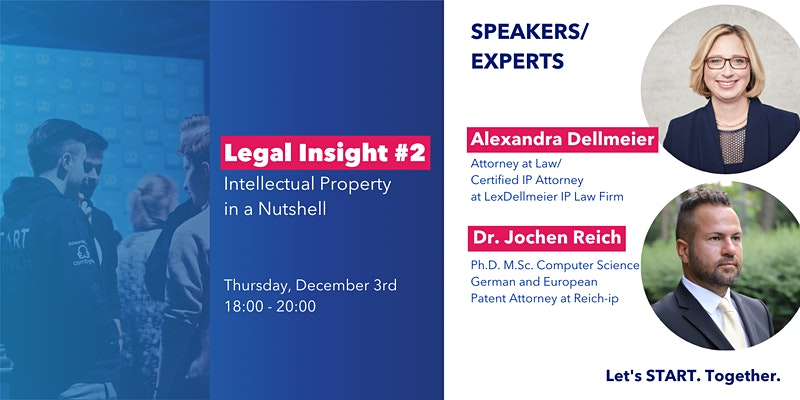
Information:
- Date: Thursday, 3 December 2020
- Time: 18:00 – 20:00
- Registration: Eventbrite
- Organizer: START Munich e.V.
- Free of charge
Speakers:
Alexandra Dellmeier, Attorney at LexDellmeier
- Attorney at Law / Certified IP Attorney
- 23 years of IP experience with a focus on trademark, designs and copyrights
- Passionate about Intellectual Property and startups
- www.lexdellmeier.com
Dr. Jochen Reich, German and European Patent Attorney at Reich-ip
- Ph.D. M.Sc. Computer Science and Patent Attorney
- 13 year of IP experience
- Expert in protection of software & software patents, E-mobility, mobile technology/telecommunications and computer hardware
- www.reich-ip.com
If trademarks are part of your daily work, you have surely come across the issue before: You have a registered trademark, but it is used differently in commerce – either because the trademark used has been modernized compared to its registered form, or because parts of the registered mark have been omitted when used or because parts have been added in comparison to the registered mark. In all these cases, the question arises whether or not use of the trademark in a form differing from the one registered can still be deemed use of the registered mark. Otherwise, your registered trademark might be at risk and action needs to be taken to ensure that no actual loss will occur. Guidance is now provided by the trademark offices of the European Union member states and the EUIPO.
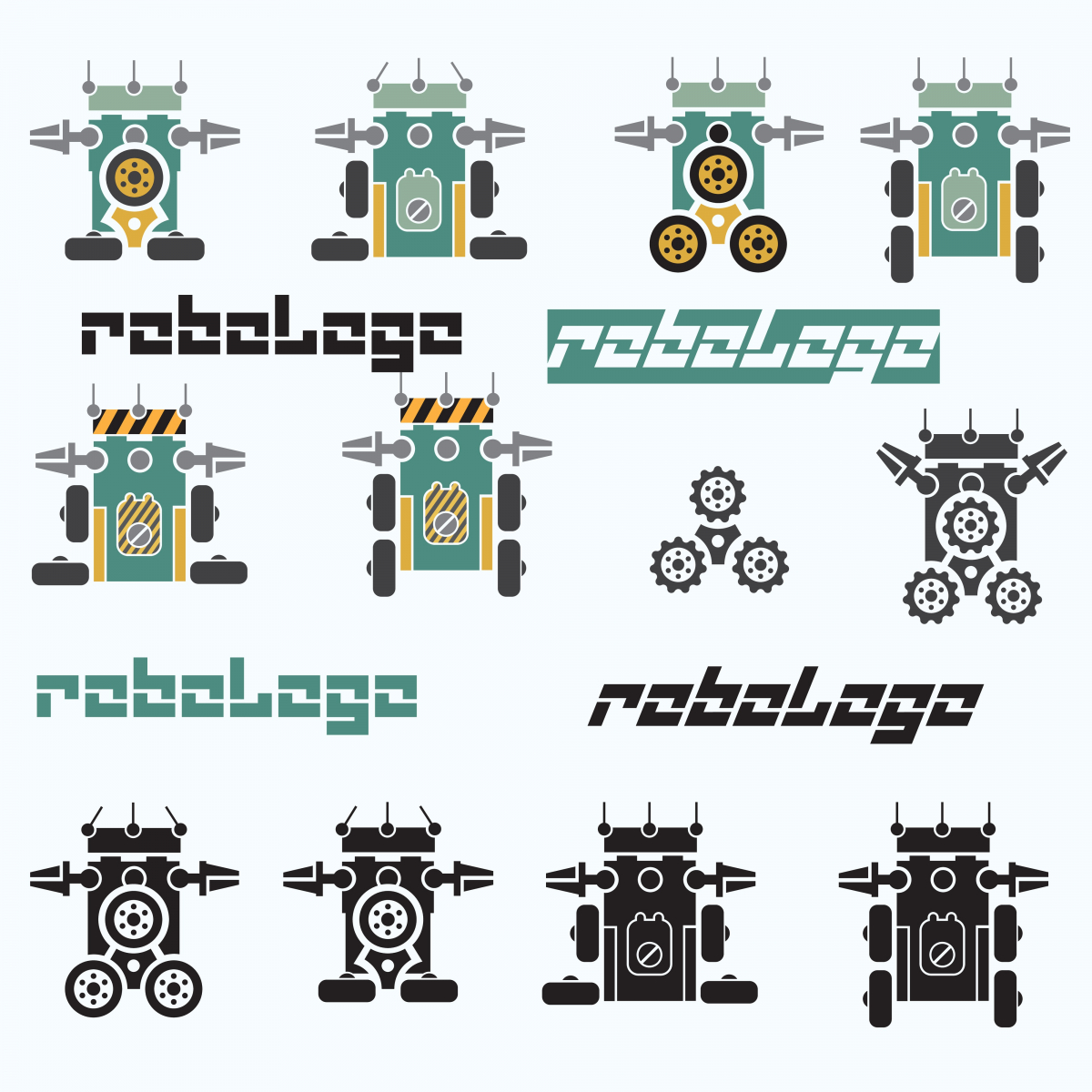
(examples of similar, but different marks)
Common Communication CP9
On 7 October 2020, we held a successful webinar in which we discussed genuine use of a trademark as one of the main topics. A week later, on 15 October 2020, the Intellectual Property Offices of the European Trade Mark and Design Network published their Common Communication CP9. In that, they agreed on a Common Practice with regard to the use of trademarks in a form differing from the one registered. The Common Practice aims at providing guidance in identifying general principles for assessing when the use of a trademark in a form differing from the one registered alters its distinctive character. The complete Common Communication with comprehensive explanations can be found at: https://www.tmdn.org/network/-/publication-of-cp8-common-communication
The following is a brief summary of the principles set out in detail in the Common Communication:
1. GENERAL APPROACH
STEP 1: Assess the sign as registered by taking into account its distinctive and visually dominant elements
STEP 2: Assess – by direct, side-by-side comparison of the two signs – whether those elements that contribute to the distinctive character of the sign as registered are present and/or modified in the sign as used
STEP 3: Assess the impact of the modification(s) on the distinctive character of the sign as registered; in particular:
2. ADDITIONS
- NOTE: It is not an addition but simultaneous use of several signs, when several signs are used together but remain independent from each other and perform their distinguishing function as separate signs.
- Distinctive element added to sign as registered -> Most likely alteration of distinctive character
- Addition of non-distinctive elements or elements of low distinctive character to a registered mark of average distinctiveness -> No alteration of distinctive character (regardless of whether these elements are visually dominant or not)
- Any addition to a registered sign of low distinctiveness -> Likely to alter distinctive character
3. OMISSIONS
- NOTE: All the distinctive elements of the sign as registered contribute to its distinctive character. Therefore, the omission of one of those elements in the sign as used is likely to alter the distinctive character of the sign as registered, unless the omitted element will be disregarded by the consumer due to its small size and/or position.
- Omission of a non-distinctive element in a registered sign of average distinctiveness -> Not likely to alter distinctive character
- Omission of an element of low distinctive character in a registered sign of average distinctiveness -> Not likely to alter distinctive character unless the omitted element is visually dominant or interacts with other elements
- If the sign as registered is composed exclusively of elements of low distinctive character and/or of non-distinctive elements, the combination of which renders the sign as a whole registrable, the omission of one or more of these elements will generally alter the distinctive character of the sign as registered
4. MODIFICATIONS (for instance typeface, size, color, position)
- Use of a word mark in a specific representation (typeface, stylization, size, colors, position) with the word still identifiable as such -> No alteration of distinctive character
- When the word as such is no longer identifiable -> Alteration of distinctive character
- Modifications of purely figurative marks -> Most likely alteration of distinctive character
- Composite marks where the distinctive character essentially derives from its verbal elements -> Use of verbal elements in modified form will not normally alter the distinctive character
- Composite marks where the distinctive character essentially derives from its figurative elements -> Use of figurative elements in modified form is likely alteration of distinctive character
- NOTE: The more an element contributes to the distinctive character of a composite mark, the more a modification of such element is likely to alter the distinctive character of the sign.
5. COMBINATION OF ADDITIONS, OMSSIONS AND/OR MODIFICATIONS
- Step 1: Assess whether any of the changes alone would lead to the alteration of the distinctive character of the sign as registered
- Step 2: Assess the effect of the combination of all changes
The above summary is intended to give you a first idea of how the trademark offices in the European Union will assess the use of a trademark in a form differing from the one registered. We strongly recommend reading the complete Common Communication CP9 for more detailed information, https://www.tmdn.org/network/-/publication-of-cp8-common-communication.
Should you need any further guidance in addition or just like a second opinion on whether or not the use of your trademark can still be deemed use of the mark as registered, you are welcome to contact us at any time by phone at +49 89 55879870 or by email to info@lexdellmeier.com. We will be pleased to discuss your case and advise.
Please also see our blog article of 29 May 2020 on the topic “Trademark Use – Always an Issue” (https://www.lexdellmeier.com/de/node/1589).
The World Intellectual Property Organization (WIPO), in cooperation with Cornell University and INSEAD, released the Global Innovation Index (GII) 2020 with its main conclusions regarding the impact of the COVID-19 crises on the innovation developments and which countries are the leaders in innovation 2020.
[[{"type":"media","fid":"5200","view_mode":"default","instance_fields":"override","attributes":{"height":270,"width":480},"field_file_image_alt_text[und][0][value]":"Global Innovation Index 2020","field_file_image_title_text[und][0][value]":"Global Innovation Index 2020"}]]
I. How COVID-19 affects innovation
Basically, the COVID-19 crisis has not changed the general growth and potential for new technologies and innovations. It is expected that the pharmaceutical and biotechnology sectors are going to experience a remarkable upturn, with the focus on health. But also traditional sectors, such as education or tourism, must adjust to the new circumstances which can lead to a rise in innovation.
Many governments are setting up rescue packages to dampen the negative impact of the crisis on the economy. However, except for the health sector, other Research and Development (R&D) areas have not been made a priority in those packages. Because of this fact, the authors of the GII 2020 report advises leaders to expand their support for innovations for the post-COVID era, especially focussing on start-ups and small businesses.
II. Global distribution of innovations
The annual ranking of the countries in terms of innovation capacity and output shows stability at the top. The top three leaders of the innovation ranking are still Switzerland, Sweden and the United States of America which all belong to the high-income group. But some Asian countries are in the ascendant. China, reaching 14th place, is the only upper middle-income country to be ranked in the top 20. But also, countries with lower middle-income economies such as India, the Philippines and Viet Nam have continuously made their way up in the ranking over the past years. All four are now in the top 50.
III. Germany in the GII 2020
According to the GII 2020 Index Germany ranks 9th, like in the past few years. It is among the countries with the highest investments in R&D and stands out with its high level and quality with respect to innovation. Regarding the new GII indicator implemented into the report, the “global brand value”, Germany takes the 11th place. It claims 149 of the world’s top 5,000 brands, even two of these brands fall within the top 25: Mercedes-Benz and Volkswagen.
IV. Cooperation in innovation is the key
In a nutshell: Most economies which climbed up in the ranking of the GII 2020 ranking are well integrated within various global innovation networks. In particular the search for a coronavirus vaccine has shown how important global cooperation is. As the WIPO Director General Francis said: “Innovations equal solutions.”
For more information please find the full report here:
October 2020 is almost over and everything is different this year. Here in Munich, we have not been able to celebrate the WIESN as the “original” OKTOBERFEST is often called. It was cancelled due to the pandemic. Usually, visitors from all over the world come to our beautiful city each year during these two weeks in fall when OKTOBERFEST it taking place. However, while the public is cursing the pandemic and has been mourning, at least the City of Munich was able to enjoy a considerable legal and trademark victory.
- Background
On 19 September 2019, we published a blog article about a then recent decision of the German Patent and Trademark Office (GPTO) which had denied trademark registration in Germany for the term “Oktoberfest” as a pure word mark. This had not been the first time that the mark had been applied for and been denied trademark registration. Different registration proceedings had been and are pending with at least the GPTO and the EUIPO. Every now and then a decision is published and the public starts discussing widely whether or not the mark “Oktoberfest” has a distinctive character.
- Latest Decision of the EUIPO
Recently, on 26 August 2020 another such decision regarding an application for the word mark “Oktoberfest” was issued – this time in an appeal proceeding pending at the EUIPO. You can read the decision in appeal proceeding no. R 1840/2019-4 regarding European Union Trademark Application No. 15535008 “Oktoberfest” (word mark) here.
In its decision, the EUIPO’s Board of Appeal very profoundly analyzed the distinctive character of the word “Oktoberfest” for the goods and services applied for and found
- that it was not an invented word created by the applicant, but a word that is commonly used to describe a festival taking place in the month of October;
- that it was only descriptive for goods and services that are a festival or are an essential part of a festival.
Thus, it rejected the mark
- for all services applied for in class 41 (mainly entertainment, sporting and cultural activities, production of audio and video tapes), as they were limited to “all aforementioned services only with regard to public festivals”;
- for all services in class 43 that are related to the offering of food and beverages;
- for all food and beverages in classes 29, 30, 32 and 33 as they include goods that are very popular and an essential part of a festival like beer, wine, non-alcoholic drinks, sausages, pretzels, roasted and sugarcoated almonds and more.
However, the EUIPO allowed the mark
- for all services in class 43 that are not related to the offering of food and beverages, but to lodging only (for instance hotel services, rental of temporary accommodation, guesthouse services, hotel reservations and temporary accommodation reservations);
- for all services in classes 35 (mainly advertising and marketing services), 38 (telecommunication services), 39 (mainly travel and transport services) and 45 (mainly licensing services);
- for all other goods designated by the application – regardless of whether or not they are sold at festivals or can be merchandise related to festivals (for instance cosmetics, candles, electronic articles, cameras, mobile phones, CDs, jewelry, all kinds of printed matter, bags, kitchen ware, textiles, clothing, shoes, headgear, artificial and fresh flowers, games, playthings, fresh fruits and vegetables, tobacco articles).
The exact list of goods and services designated by European Union Trademark Application No. 15535008 “Oktoberfest” (word mark) can be found at the link given above.
- Implications of the Decision
Should the decision of the Board of Appeal not be appealed further by the applicant and should no opposition be raised, the term “Oktoberfest” will be registered with the EUIPO as a word mark and gain protection in all 27 member states of the European Union.
Does this mean that nobody else except the City of Munich can use the term “Oktoberfest” for goods and services of a festival as has been reported on some internet platforms? No, it does not. If you are organizing a festival in October, you can still call it “Oktoberfest” and food and beverages can be sold freely. However, be careful when selling goods and services for which the EUIPO allowed registration of the term “Oktoberfest” as a trademark. You can use the term if it is merely to describe a specific feature of a good/service, but we recommend not using it in a trademark sense as it cannot be ruled out that the City of Munich may one day enforce its trademark rights – should they eventually get registered.
For any questions regarding use of the mark “Oktoberfest”, you are welcome to contact us at info@lexdellmeier.com or by phone at +49 89 55879780.
For the last two months, Oliwia Puto – our Legal Trainee was working on her Overall Project, which was the creation of a chatbot “BenBot” for LexDellmeier. “BenBot” is a mobile app that aims to facilitate and accelerate the process of filing applications for the registration of an EU trademarks. In order to achieve this purpose, it collects from the users all information that the attorneys at LexDellmeier need to prepare such applications. We are delighted to announce that this project will officially go live around December 2020/January 2021. This means that in just a few months you will be able to download the app from AppStore and use it to receive information on matters related to trademarks, IP law etc., and to send information needed to apply for an EU trademark registration – 24/7! What makes us particularly excited about this project is that (as far as we know) LexDellmeier will be the first law firm in Germany to implement a Legal Tech solution of this kind. Read the blog post to find out more!
Hello! Here is Oliwia again. In this blog post I will talk about “BenBot” and broader about the Overall Trainee Project I completed during my three-month internship at LexDellmeier, in particular what it involved and what I have learned from it. To start off, you might have noticed that in the past few years chatbots have gained in both significance and popularity. In fact, according to Forbes, as much as 80% of marketers plan to start using a chatbot in some way or another by 2020. But, what exactly are they? And what benefits can they bring to businesses? Well, a chatbot is a software application used to conduct an on-line chat conversation, instead of providing direct contact with a live human. As such, chatbots can assist people in many different areas of daily life, most notably (but certainly not only!) by providing customer support. They are very beneficial both for businesses and clients, as they reduce the waiting time, are available 24/7 and help save costs. Moreover, since they are creative and fun, clients like using them. Importantly, they usually enjoy high success and satisfaction rate.
As an innovative and client-oriented law firm, LexDellmeier realised that implementing a chatbot can both enhance the experience of its clients and reduce the workload for the attorneys. Therefore, one of the main tasks I was assigned during my Traineeship was to create a program that will facilitate and accelerate the process of filing applications for the registration of EU trademarks. The outcome of this project is called “BenBot” (it owes its name to a very sweet dachshund Ben – LexDellmeier’s office dog that some readers will already know from last year’s Xmas card), and is an app for mobile devices with iOS. It works in the following manner: the chatbot asks questions to the user and the user replies to them by clicking on one of the available options or typing answers. In this way, “BenBot” collects all information that the attorneys at LexDellmeier need to prepare an EU trademark application. Once the user has answered all the questions, “BenBot” extracts all relevant parts of the conversation and combines them into a form which is sent to LexDellmeier. The attorneys can then review the answers and get back to the client with professional legal advice. In addition to these key functions, “BenBot” can perform identity searches for the user and help them create the list of goods and services. Sounds quite awesome, right?!
The creation of “BenBot” was one of the tasks I enjoyed most during my internship at LexDellmeier. At the same time, it allowed me to develop numerous skills that are vital in the legal profession as well as to enhance my understanding of IP law. As a part of the project, I was assigned two different types of activities. Firstly, with help from other team members, I was responsible for the overall organisation. I have to admit that managing the work of four people was not an easy task, especially taking into account that different team members had different backgrounds and priorities (legal vs technical). However, it felt rewarding to see that the teamwork, communication and planning are improving with every meeting. Second, I was responsible for providing the “legal” input into the project. This included structuring and drafting dialogues for the chatbot, preparing the terms and conditions of the use of the app and updating LexDellmeier’s privacy policy. While I found these tasks very interesting, the part of the project I enjoyed most was applying for the registration of a trademark “BENBOT” in the EU and Germany. During this process, I got involved in the drafting of the list of goods and services, performed the searches for similar and identical trademarks, evaluated the outcomes of these searches and summarised them in a form of a report. It felt truly amazing to know that I was doing tasks normally carried out by qualified IP attorneys.
Currently “BenBot” is still undergoing some technical improvements, and therefore will most likely go live around December 2020/January 2021. Stay tuned to see the final result of my project and I hope you will like it as much as I do!
On Wednesday, 1 July 2020, LexDellmeier held its two webinars no. 6 and 7 on the topic “Design Law Basics” (German: Designrecht 1 x 1). During the approx. 75 minutes presentation, Andrea Breier and Alexandra Dellmeier outlined what a design is from the legal point of view, explained how to acquire a design right and talked about the importance of design protection. As usual, we recorded the webinar and published it on YouTube – you will find the link in the post below!
Whether you are looking at a Nike shoe, an iPhone or at a BMW car - designs surround us everywhere. From a legal perspective it is crucial to think about them as important intellectual property rights. If you wonder why, let us explain – in some industries (e.g. automotive), designs make up for as much as 10 - 20 % of the company value. As we are talking about billions of dollars, it becomes clear that an effective protection of design rights is a key concern for numerous brand owners and businesses.
As a starting point, it is necessary to answer the question what exactly a design is. From the legal point of view, a design must possess two characteristics: it must be novel and it must have individual character.
The second crucial question is how to acquire a design right. Analogically to trademarks, different systems of design protection exist on national, European and international level. Depending on various considerations, such as cost, duration of the registration process or geographical scope of protection, one system may be more suitable for you than the others. Moreover, before applying for the registration of a design, you should bear in mind that other intellectual property rights (e.g. trademarks or copyright) exist that can offer you IP protection too. However, the prerequisites and legal consequences, including the duration of protection, are completely different.
Our webinar gives a more in-depth insight in all the issues mentioned above. Therefore, if you want to make informed decisions when applying for a design, simply learn more about IP law or are curious what strategy Nike has for registering its shoe designs, make sure to watch the recording published on YouTube!
PowerPoint presentation to download (PDF):[[{"type":"media","fid":"5190","view_mode":"default","instance_fields":"override","link_text":"20200701_termin_7_webinar_final_design_law_basics_eng.pdf"}]]
Link to the recording on YouTube: https://www.youtube.com/watch?v=mvr09qNI_Lw
Content of the webinar “Design Law Basics” (German: “Designrecht 1 x 1”) in English
- Introduction–Economic value of a design
- What is a design from a legal point of view?
- How to acquire a design right?
- Possibilities and recommendations for design applications
- Strategic considerations
- Which benefits can be derived from a design?
- Conclusion and outlook on the next webinars
- Q & A
On 7 August 2020, all attorneys, paralegals and trainees at LexDellmeier met at the picturesque Lake Starnberg in Bernried (approx. 25 km from Munich) to hold its annual Strategy and Team-Day Meeting. Although the main aim of the meet-up was to discuss three key topics: digitalisation, client needs during Covid-19 and Brexit, it was also a great opportunity for the team members to finally gather all together (of course, with social distancing measures in place!) after a very long break caused by COVID-19. Some of the LexDellmeier team had been working non-stop from home for the past four to five months. Working web-based or via Teams or Zoom from the home offices has had some advantages (like no commuting time etc.). However, it is always really good to have in-person meetings at least once in a while. Even though home office is still done by some employees, others prefer to come to the office and meet up with colleagues in person – to discuss legal issues or to have a personal chat or just a coffee together. We have hygiene and social-distancing policies in place at the firm and we believe to have found a good balance between working from home and being on site at the office headquarter. Like all our colleagues and clients around the world – work is continuing – just the circumstances are somewhat different during these challenging times.
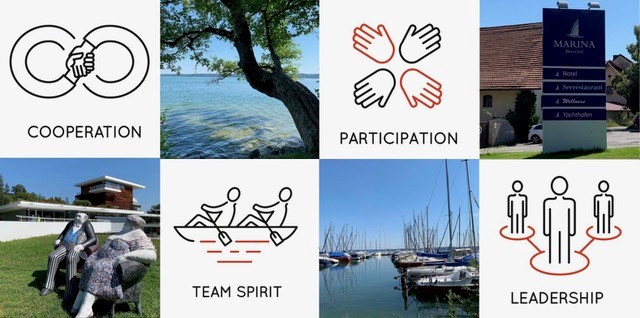
Teamwork, cooperation and participation – these words may sound clichée in the business world, but, LexDellmeier understands that their importance cannot be underestimated. Accordingly, the firm regularly organises Strategy Meetings, during which it summarises its most important achievements and set goals for the future. These gatherings also give all team members the chance to give their feedback and suggest ideas for improvement, and as such are a key contribution to LexDellmeier’s success.
This year’s Strategy Team-Da Meeting took place in Bernried, which is a small town located at Lake Starnberg in southern Bavaria. Sitting in a conference room overlooking the water, surrounded by stunning nature, the team was more motivated than ever to discuss LexDellmeier’s strategic plan for the upcoming months. The first key topic was digitalisation. Since 2018 LexDellmeier has been “going green” with the aim to become fully paperless in the near future. Fact is though, that the German courts are hardly paperless at all yet – this is planned to be implemented as of the year 2020. Therefore, it was crucial to evaluate how our internal electronic docketing system has been performing so far and what still needs to be improved and to update everyone on the digitalization status of German courts, the German Patent and Trademark Office etc. The second main point on the agenda concerned LexDellmeier’s clients. In particular, the team discussed what the firm can do to better understand clients’ needs and fulfil their expectations and take into consideration the special circumstances of Covid-19. As the third key topic LexDellmeier debated Brexit. This part of the conversation focused on what steps the firm must take to adopt to the new reality of the UK leaving the EU regarding EU Trademarks and EU Designs as well as International Registrations designating the EU as of 1 January 2021. As you can see, the day was full of intense discussions and follow-up work to do by various team members.
After the official part, LexDellmeier went for lunch outside to a restaurant nearby. This gathering felt very unique as it was the first time since the beginning of COVID-19 that all team members could meet in one place and simply spend some time together in a relaxing and very airy atmosphere. It was great to see everyone happy and in good health! Apart from enjoying great food and catching up with each other, the team of LexDellmeier made sure to make the most out of being in place as beautiful and peaceful as Lake Starnberg. Some visited Buchheim’s Museum of Phantasy, which has an exceptional collection of Expressionist art and admired traditional Bavarian architecture when walking around Bernried. Overall, it is fair to say that the trip to Starnberg was not only beneficial from the firm’s strategic point of view, but, more importantly, it also allowed team members to bond and enjoy a summer day together. If you are curious how this beautiful place looked like, make sure to visit our Instagram account: https://www.instagram.com/lexdellmeier/.
Wie hoch ist der durchschnittliche Wert einer Marke am Unternehmenswert? Ist der Wert von Branche zu Branche unterschiedlich hoch? Und was bedeutet „brand valuation“ und „brand evaluation“ eigentlich genau? Diesen und anderen wichtigen Fragen rund um das Thema Markenrecht und -wert widmete sich Alexandra Dellmeier bei der Web-Seminarreihe des Bundesverband mittelständische Wirtschaft Unternehmerverband Deutschlands e.V. (BVMW Bayern).
ISO-Standards zur Bewertung einer Marke
„46 Prozent beträgt der Anteil einer Marke durchschnittlich am Unternehmenswert“, erklärte Alexandra Dellmeier. Damit kommt der exakten Bewertung einer Marke eine wichtige Rolle zu. Die Bewertung eine Marke kann grundsätzlich auch anhand von nicht- finanziellen Faktoren vorgenommen werden: Hierfür bieten sich seit diesem Jahr neue ISO-Standards an, mit denen der Wert einer Marke auch unter Marketing-Aspekten und ihrer rechtlichen Durchsetzbarkeit evaluiert und gemessen werden kann.
Markenrecht: Separate Anmeldung in UK nach dem Brexit erforderlich
Auch widmete sich Alexandra Dellmeier den Folgen des Brexits für Marken oder Designs in der EU im Webinar. Zu den Auswirkungen des Brexits auf EU-Marken und Designs gehört, dass eine bestehende EU-Marke oder ein EU-Design ab 2021 in eine eigene nationale britische Marke (oder ein britisches Design) umgewandelt wird. Neue Markenanmeldungen in der EU entfalten ab diesem Stichtag keine Wirkung mehr in UK und müssen separat angemeldet und bezahlt werden. Ab 2021 müssen die EU-Marke und die zusätzlich bestehende UK-Marke dann auch separat verlängert werden.
Für alle diejenigen, die das Webinar verpasst haben, hier gibt es die Präsentation dazu:
/sites/default/files/20200721_final_bvmw_lexdellmeier_webinar_2020_002.pdf