

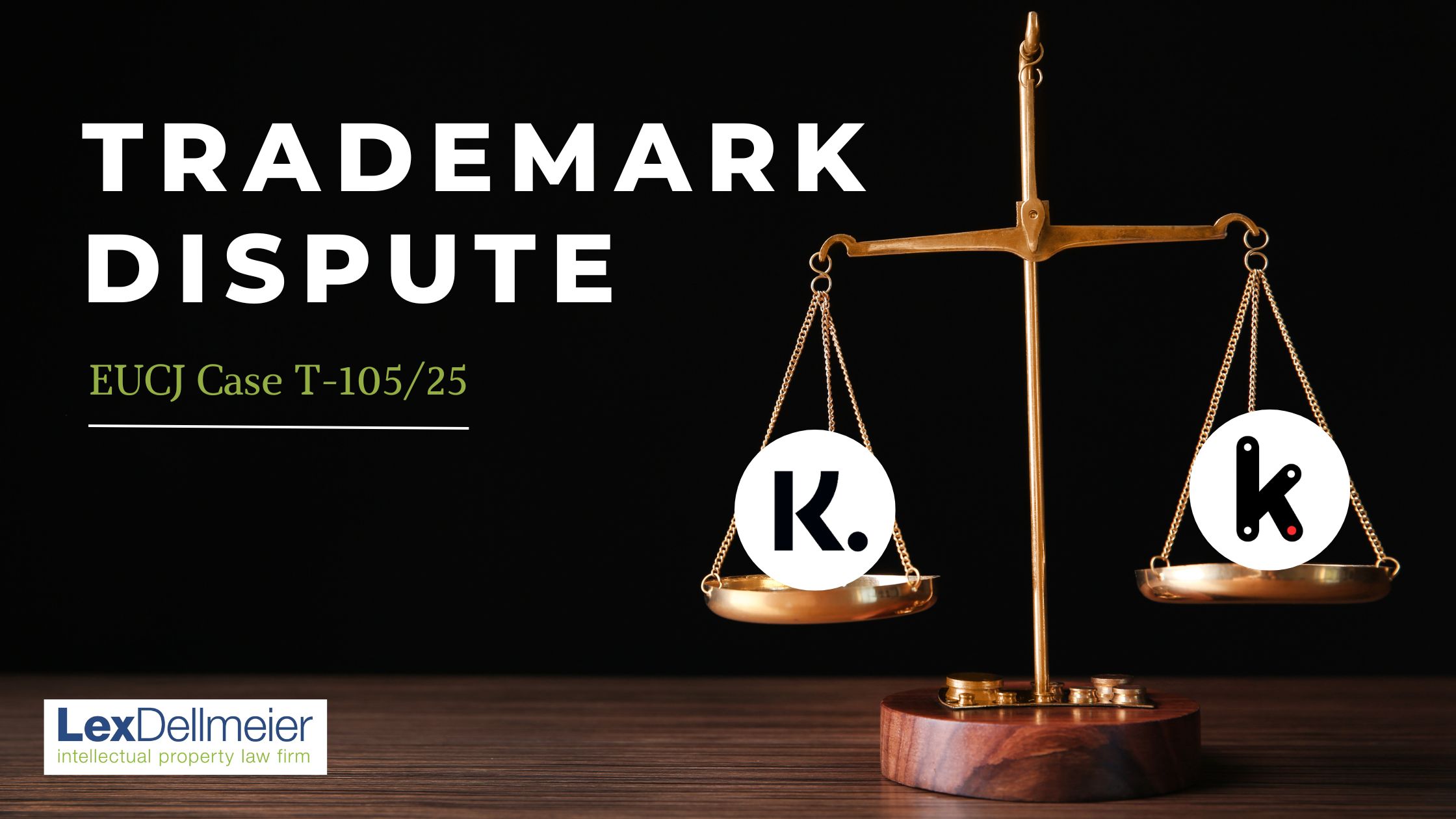
On 13 May 2026, the General Court of the European Union delivered its judgment in Case T‑105/25, concerning a trade mark dispute between Kutxabank, SA and Klarna Bank AB. The dispute arose after Klarna filed an EU trade mark application for a figurative sign featuring the letter “k”. Kutxabank opposed the application on the basis of likelihood of confusion with its earlier trademarks, which also depict a stylized letter “k”. After proceedings before the EUIPO, the matter reached the General Court, whose judgement is the focus of this case summary.
Background
In August 2017, Klarna filed an application for an EU figurative trade mark covering services in Classes 35, 36, 39, 42 and 45. In November 2017, Kutxabank opposed the application in respect of all services claimed. The opposition was based on two earlier rights:
- Earlier Mark 1 (2014): a stylized “k” registered for services in Class 36
- Earlier Mark 2 (2013): the same stylized “k” combined with the verbal element “kutxabank kredit”, registered for Classes 35 and 36
The opposition relied on Article 8(1)(b) of Regulation No 207/2009, alleging a likelihood of confusion.
In May 2019, the Opposition Division upheld Kutxabank’s opposition in respect of all the contested services. Klarna appealed this decision, and the Board of Appeal subsequently partially annulled the Opposition Division’s ruling. Specifically, it rejected the opposition for the services in Classes 35, 39, 42 and 45, while upholding it for the services in Class 36.
In the proceedings before the General Court, Kutxabank sought annulment of the contested Board of Appeal decision insofar as it dismissed the opposition for four service classes. Klarna, in turn, filed a cross‑claim requesting annulment of the remaining part of the decision that had upheld the opposition for Class 36.
Applied mark (Klarna) Earlier Mark 1 Earlier Mark 2



Similarity of goods and services
The Court recalled that similarity must be assessed by considering all relevant factors, such as:
- The nature, purpose and method of use of the services
- Whether they are in competition or complementary and
- Whether consumers expect them to come from the same undertaking
In this case, the services covered by the earlier marks belonged mainly to the financial and banking sector, such as insurance, financial affairs and monetary services in Class 36, as well as general business support services in Class 35. By contrast, the services covered by the applied‑for mark were related to:
- Accountancy and invoicing (Class 35)
- Technological and software‑related services (Class 42)
- Security and investigation services (Class 45)
- Logistics and transport (Class 39)
The Court agreed with the Board of Appeal that these services do not share the same nature or purpose, do not satisfy the same needs of the public, and are not offered by the same types of professionals. They also do not share the same commercial origin or distribution channels.
The only class in which the services were treated as identical was Class 35, as the EUIPO had found identity and Kutxabank had not contested that finding. For this class, the Court proceeded to examine whether the signs themselves were similar and, consequently, whether a likelihood of confusion could arise.
Similarity of signs
The comparison of signs focused on the applied‑for mark and Earlier Mark 2, as this earlier mark covered the identical Class 35 services. The Court assessed visual, phonetic and conceptual similarity based on the overall impression of the marks.
Although the verbal elements “kutxabank” and “kredit” appear in smaller font and in the lower part of the sign, the Court held that they remain sufficiently noticeable for the relevant public. They therefore form an essential component of the mark, meaning that the comparison had to be carried out on the sign as a whole rather than focusing solely on the stylized letter “k”.
The Court found:
- Visual similarity: only low, due to differences in stylization and the presence of verbal elements “kutxabank” and “kredit” in Earlier Mark 2.
- Phonetic similarity: very low, as the applied‑for mark consists of a single letter while Earlier Mark 2 contains two full words.
- Conceptual similarity: none, since “kutxabank” evokes the idea of a bank, whereas a single letter conveys no semantic meaning.
Likelihood of confusion
Although the services in Class 35 were identical, the signs displayed only a low degree of visual similarity, a very low degree of phonetic similarity and no conceptual similarity. Earlier Mark 2 was considered to have an average degree of distinctiveness, and the relevant public was deemed to display a high level of attention. In light of these factors, the Court concluded that there was no likelihood of confusion. The main action was dismissed in its entirety, and the EUIPO’s decision was upheld.
Klarna’s cross-claim
Klarna appeared before the General Court with a cross‑claim, arguing that the Board of Appeal erred in finding a likelihood of confusion for the Class 36 services. Klarna did not dispute the Board’s conclusion that the Class 36 services were identical, but challenged only the assessment of similarity between the signs. As a result, the Court had to examine whether the applied‑for sign and Earlier Mark 1 were similar, an assessment more complex than in the main action, given that both signs consist of a single stylized letter “k”.
The court found:
- Visual similarity: higher than average, due to the nearly identical element of a slightly stylized letter “k”, irrespective of certain stylized aspects, such as the dots, which differentiate the signs.
- Phonetic similarity: identical, as both signs are perceived as the letter “k” and are therefore pronounced the same way.
- Conceptual similarity: none, as no conceptual comparison could be carried out because it was not shown that the letter “k” had any particular meaning.
Taking the above observations into account, and noting that the earlier mark had average distinctiveness while the relevant public was considered to have a higher level of attention, the court concluded in its overall assessment that a likelihood of confusion existed in the present case. This was particularly due to the above-average visual similarity of the signs, their phonetic identity, and the identity of the services at issue. In other words, the court agreed with and upheld the Board of Appeal’s finding that a likelihood of confusion was present. The cross-claim was therefore dismissed in its entirety.
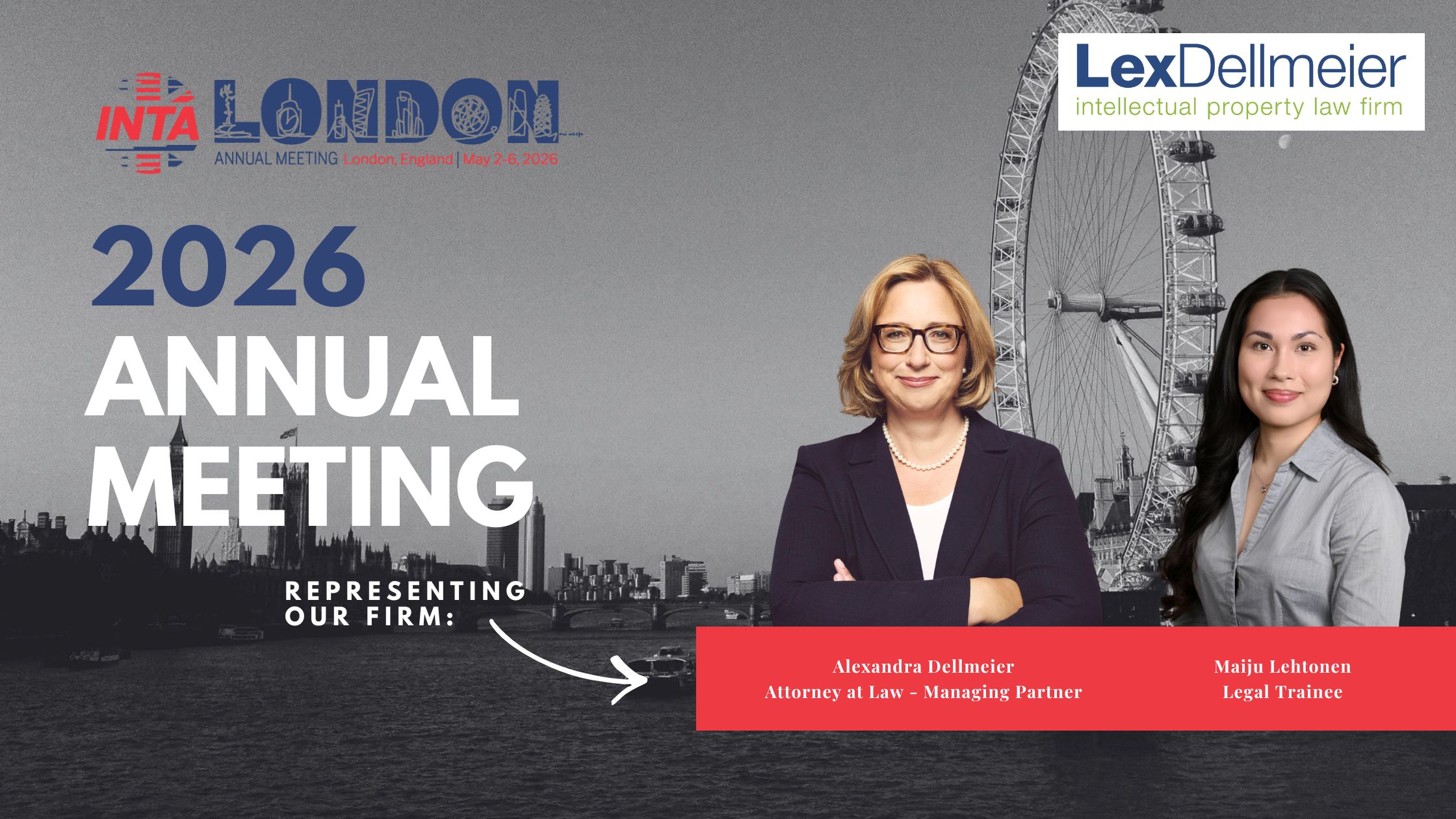
INTA 2026 Annual Meeting is approaching faster than you think. Each year, the International Trademark Association (INTA) brings together more than 10,000 IP professionals from around the world for a week of networking, education, and discussions on the latest developments in IP. This year’s meeting takes place in London on 2–6 May 2026, and LexDellmeier will be represented by Attorney at Law and Managing Partner Alexandra Dellmeier together with our firm’s Legal Trainee Maiju Lehtonen.
About INTA and the Annual Meeting
INTA is a global non-for-profit association founded in 1878 that promotes understanding and respect for IP rights, helping to enhance the economic and social value of brands. Its members include brand owners and IP professionals committed to advancing this mission. Today, INTA comprises more than 6,600 member organizations across 182 jurisdictions, representing nearly 38,000 professionals. Members include brand owners from companies of all sizes, as well as law firms, government agencies, academics, and law students.
A key part of INTA’s work are its events, particularly the Annual Meeting, which is not only INTA’s largest event but also the largest gathering of brand owners and IP professionals in the world. It brings together thousands of brand owners and IP professionals from across globe for an engaging week filled with opportunities for networking, education, and insights into the latest developments shaping IP practice. This year, the 148th Annual Meeting will be held in the vibrant city of London, England, with over 9,000 registrants from 146 jurisdictions to date.
Trending topics at INTA 2026 Annual Meeting
The Annual Meeting will feature a rich lineup of sessions covering themes ranging from law and policy to understanding brand value in business, and perhaps the most talked-about topic or the year: technology and AI shaping the future of IP. Discussions will tackle themes such as AI-driven advertising and the legal challenges it raises, the impact of AI regulation on brand strategy, and more broadly, the skills and strategies required in an increasingly tech-driven IP landscape.
Education is a central part of the Annual Meeting, and the program therefore offers a wide variety of sessions designed to inform and engage attendees. These include a broad range of formats such as general and featured sessions led by experienced practitioners, interactive table topic discussions focused on idea-sharing, and daily keynote presentations from influential speakers intended to spark conversation and offer fresh perspectives, among other session types. In addition, the Meeting provides plenty of informal opportunities to connect and network, such as receptions, workshops and the Innovation Marketplace at the ExceL London convention center.
LexDellmeier at INTA 2026 Annual Meeting
As the INTA 2026 Annual Meeting in London is now less than two weeks away, we are excited to announce that LexDellmeier will be attending. Representing the team this year will be our Managing Partner, Attorney at Law Alexandra Dellmeier, and our Legal Trainee Maiju Lehtonen.
With almost 25 years of experience in the IP field and as a seasoned attendee of the Annual Meeting, Alexandra is eager to meet and reconnect with clients, colleagues and friends in London. For Maiju, this will be her very first Annual Meeting. She is delighted to have the chance to join Alexandra in associate and client meetings, as well as take part in the wide range of insightful sessions covering today’s most relevant IP topics. Above all, we are looking forward to experiencing the unique atmosphere of the IP community at the year’s leading IP event.
Combining seasoned experience with fresh newcomer energy, LexDellmeier’s team is ready for this year’s Annual Meeting. One thing is certain; we intend to make the very most of this opportunity to connect in person with clients and colleagues around the world. From strengthening existing relationships to building new connections across the IP community, we are excited about an inspiring and productive week in London!
Stay tuned for more INTA updates on our social media channels – see you in London!
Every year on 26 April, the world comes together to celebrate World Intellectual Property Day, an initiative created by WIPO to highlight the value of ideas and the rights that protect them. This year, the celebration brings the energy of sports and the impact of innovation into the spotlight. Join us as we explore how intellectual property keeps the world of sports creative, competitive and constantly evolving.
1. What is World IP day?
As nearly every important topic seems to have its own dedicated day (yes, even coffee and emojis have made the list), it is only fair that intellectual property has one too. Every year on 26 April, the world celebrates World Intellectual Property Day, a day dedicated to shining a spotlight on the power of ideas and the rights that protect them. The date marks the 1970 entry into force of the WIPO Convention, a milestone in celebrating innovation worldwide.
Since its launch in 2000, World IP Day has explored a new theme each year. Recent campaigns have highlighted topics such as Women and IP (2023), IP and the Sustainable Development Goals (2024), and IP and Music (2025). This year, things get a little more energetic with IP and Sports: Ready, Set, Innovate (2026), celebrating the creators, inventors, entrepreneurs, and athletes who shape the sports industry.
At its core, World IP Day celebrates creativity and innovation in all areas of life. It also aims to bring intellectual property closer to everyone, not just legal specialists. Whether we notice it or not, IP is part of our everyday lives: in the logos on our favourite jerseys, the technology in our running shoes and the highlights we stream after a big game. In other words, IP is not just a legal concept, it is something that actively shapes how we live, work, and experience the world.
2. World IP Day 2026 Theme: IP and Sports
This year, World IP Day dives headfirst into the world of sports with the theme “IP and Sports: Ready, Set, Innovate.” When we think about sports, our minds often go straight to the game itself, the thrill of competition and the roar of the crowd. But sports reach far beyond the field or arena. They influence fashion, entertainment, media, health, gaming, and even consumer goods.
Once we step off the field and look at the business and economic side of sports, intellectual property quickly comes into play. IP rights protect the work of the inventors, designers, and creators working behind the scenes, those who develop cutting-edge equipment, craft immersive fan experiences, and make sports accessible to everyone, even from the comfort of their own home.
IP ensures that the innovators and creators who keep sports thriving receive the recognition and fair rewards they deserve. This matters because the future of creativity and innovation depends on how much value we place on these contributions today. IP forms the foundation of the global sports economy and connects the many industries surrounding sports, allowing us to keep enjoying the spirit of the games, exciting events, and top-tier athletic performances.
3. Short Overview of IP in the Sports Business
To give you a better sense of how sports and IP come together, here are some key IP rights in the sports industry:
- Sports Patentsprotect new and inventive sports technologies and equipment, such as running shoes and swimsuits, by giving manufacturers exclusive rights to their innovations.
- Sports Trademarks safeguard the names, logos, symbols, slogans and other distinctive signs of teams, athletes and brands, distinguishing their products from others while helping fans recognize what is authentic.
- Sport Product Designs protect the unique appearance of sports equipment and apparel, such as the shape of a running shoe or the look of a swimsuit, helping brands stand out from competitors and preventing others from copying their designs.
- Broadcasting and Media Rights give broadcasters the exclusive authority to transmit live sports events, allowing them to earn back their investment in coverage while providing sports organizations with essential revenue to fund and grow the sport.
4. Get involved with World IP Day 2026
You can take part in the World IP Day 2026 celebrations through a wide range of activities. For example, you might launch a sport innovation mentoring program offering free IP and business consultations, or give athletes, fans and IP experts a platform to share their stories through radio shows, sports programs or podcasts. You can also help promote IP awareness in sports by writing short blog posts or social media updates about how intellectual property supports innovation across the sports sector.
If you want an easy way to join in, you can simply share your passion for sports by posting your favourite moments on social media using the hashtag #WorldIPDay and tagging @wipo. Communities and companies can join the celebration by hosting IP and sports themed events such as webinars, workshops or competitions. Young creators are also invited to take part in the World IP Day Youth Video Competition by submitting a 60 to 90 second video showing how IP fuels innovation in sports. Our firm will also be sharing World IP Day content on social media, so stay tuned!
The EU courts have published their 2025 judicial statistics, revealing important developments in workload, case duration, and the distribution of different types of proceedings. These trends matter directly for practitioners appearing before the Court of Justice and the General Court. This summary highlights the key figures and explains what they mean, with a particular focus on IP litigation.
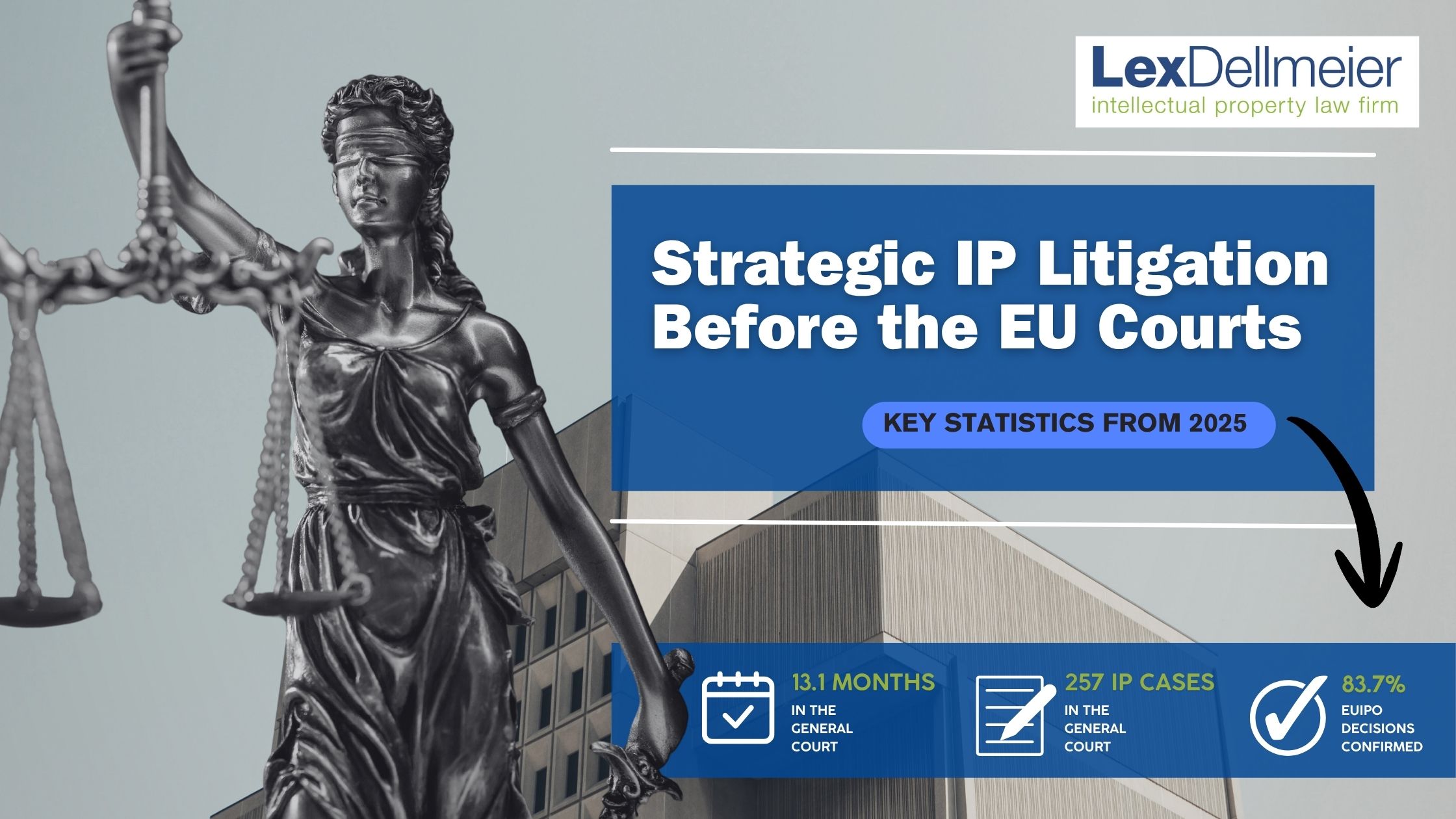
For intellectual property practitioners, the statistics confirm that IP litigation before the EU courts is both high in volume and procedurally stable. At the General Court, 303 IP cases were closed in 2025 with an average duration of 13.1 months, showing that EUIPO appeals continue to move efficiently despite representing roughly a quarter of the Court’s entire caseload.
At the Court of Justice, IP activity remained limited: 39 EUIPO appeals and 11 preliminary references were lodged, illustrating that only a small proportion of disputes progress beyond the General Court.
Finally, EUIPO’s 2024 data shows that 83.7% of Board of Appeal decisions were confirmed by the EU courts, indicating that overturning an EUIPO decision remains relatively rare. While the 2025 confirmation rate is not yet available, the trend suggests a high level of stability in outcomes.
Here is a full overview of the statistics:
1. Overall Overview (both courts)
- Cases brought: 1,878 (up from 1,706)
- Cases closed: 1,898 (up from 1,784)
- Pending cases: 2,489 (down from 2,509)
A key development in 2025 was the reform transferring jurisdiction for certain preliminary rulings (in six specific areas) from the Court of Justice to the General Court.
2. The Court of Justice
- Cases brought: 889 (slightly down from 920)
- Cases closed: 774 (stable compared with previous years)
- Pending cases: 1,322 (up from 1,207)
- Average duration of proceedings: 16.7 months (down from 17.7 months)
- Requests for preliminary rulings: significant number of requests made by Italian (110) and Polish (63) courts
3. The General Court
- Cases brought: 989 (+26%, highest ever)
- Cases closed: 1,124 (+22%, highest ever)
- Pending cases: 1,167 (lowest since 2007)
- Average duration of proceedings: 16 months (down from 18.5 months)
Requests for preliminary rulings: total of 65 requests from 17 different member states, with Germany contributing the highest number (21)
Trends in Direct Actions:
- Intellectual property: slight decrease (-4%)
- Civil service cases: strong increase (+43%)
- Restrictive measures: strong increase (linked to the Russia-Ukraine war)
- Economic/monetary policy cases: notable decrease
4. Intellectual Property Cases
The Court of Justice
- Cases brought: 51 (same as 2024)
- References for a preliminary ruling: 11
- Direct actions: 1
- Appeals: 39
- Cases closed: 53 (up from 51)
- Judgements/opinions: 21
- Orders: 32
The General Court
- Cases brought: 257 (down from 268)
- Cases closed: 303 (up from 276)
- Judgments: 242
- Orders: 61
- Pending cases: 276 (down from 322)
- Average duration of proceedings: 13.1 months (slightly up from 12.8 months)
Conclusion
The overall workload of the EU courts remains high, but the average duration of proceedings decreased in both courts. The General Court’s performance improved significantly, closing a record number of cases and reducing its backlog to the lowest level in 18 years.
The Nice Classification, an international system used to classify goods and services for trademark registration, has been updated. The new 13th edition entered into force on 1 January 2026. These changes to the classification can significantly affect trademark searches and ignoring them may lead to missing earlier trademarks and serious legal consequences.
The Nice Classification forms the backbone of trademark registration by organizing the world of goods and services into 45 clearly defined classes, 34 for goods and 11 for services. However, as markets constantly evolve and new products emerge, the classification must adapt accordingly.
It is therefore reviewed and revised on an annual basis. Each updated version is published online by the World Intellectual Property Organization (WIPO) and enters into force on 1 January of the relevant year.
In addition to these annual updates, a more comprehensive revision is carried out every five years. However, in the near future, these major revisions are expected to take place every three years, reflecting the increasing number of new goods and services entering the market that need to be defined within the classification.
To help you get acquainted with the newest 13th edition of the Nice Classification, which came into force on 1 January this year, we begin with a short case study. This example illustrates the practical impact of these changes and why it is important to take them into account.
We then provide clear, step-by-step instructions on how to find these updates on WIPO’s website. Finally, this article highlights the most notable changes in a concise bullet-point format, allowing you to quickly understand the key developments in the latest edition.
Case Study
Imagine you have created a brand called “Superdrip” and plan to use it for sunglasses. Before applying for a trademark, you check whether any identical or similar marks are already registered. Sunglasses currently fall under Class 10 in the Nice Classification, so you conduct your search in that class and are pleased to find no conflicting marks. Confident, you go ahead and file your trademark application in Class 10.
A few weeks later, however, you receive a cease-and-desist letter from Superdry, claiming that your mark infringes their existing trademark. How could this happen? The issue lies in the fact that sunglasses were previously classified under Class 9. Superdry holds earlier trademarks in that class, which remain valid. Because you only searched Class 10, you missed these earlier registrations.
As a result, you now face a potential legal dispute, unnecessary costs, including application fees, branding investments, and lost of time, all of which could have been avoided by considering the changes in the Nice Classification during your search.
This case highlights an important lesson: when conducting trademark searches, you should always check both the current class of the relevant good or service and any classes that previously covered it.
How to Check the Changes in the New Nice Classification:
- Go to the website: https://nclpub.wipo.int/enfr/.
- In the “EDITION-VERSION” field in the top-left corner, select 13-2026.
- From the “CLASS INDEX” on the left side, choose the class you want to review.
- Once the page opens, select “Modifications” from the top menu.
- You will then see all changes that apply to that class.
Major Changes Listed:
Goods:
- Essential oils are now classified according to their purpose. As a result:
- Essential oils for use in manufacture (010744) are now classified in Class 1
- Essential oils for fragrancing (030286) remain in Class 3, together with other fragrance products
- Food flavourings consisting of essential oils (300048) are now classified in Class 30, whereas previously they may have been classified in Class 3
- Terpenes [essential oils] (010743) have been transferred from Class 3 to Class 1
- Spectacles, contact lenses and sunglasses have been transferred from Class 9 to Class 10. For example:
- Spectacles* / eyeglasses (100328), contact lenses (100335) and sunglasses (100339) are now classified in Class 10
- Emergency and rescue vehicles have been transferred from Class 9 to Class 12. For example:
- Fire engines (120352), fire boats (120353) and lifeboats (120355) are now classified in Class 12
- Surf skis (120358) have been transferred from Class 28 to Class 12
- Nozzles for watering hoses (170141) have been transferred from Class 21 to Class 17
- Clutch linings have been removed from Class 17 and are now classified according to their use. As a result:
- Clutch linings for land vehicles (120350) are classified in Class 12
- Clutch linings, other than for land vehicles (070623) are classified in Class 7
- The classification of parasols and umbrellas has been clarified. As a result:
- Parasols have been revised to “hand-held parasols” (180066) in Class 18, and a new entry “patio umbrellas” (220125) has been added to Class 22. This change clarifies that Class 18 covers only hand-held parasols and umbrellas.
- Tongue scrapers (210479) have been transferred from Class 10 to Class 21
- Electrically heated clothing that is not intended for protection against accidents or injury, nor for medical purposes, has been transferred from Class 11 to Class 25. For example:
- Electrically heated clothing (250206), electrically heated socks (250207) and footmuffs, electrically heated or not electrically heated (250208), are now classified in Class 25
- Yoga articles are now classified according to their nature. As a result:
- Yoga cushions (200382) and meditation cushions (200381) are classified in Class 20
- Yoga gloves (250210) are classified in Class 25
- Meditation mats (270029) are classified in Class 27
- Yoga blocks (280291) are classified in Class 28
- Buttercream [icing] (300329) has been transferred from Class 29 to Class 30
Services:
- Artificial intelligence as service [AlaaS] (420315) has been added as a new entry to Class 42.
- Booking and arranging of access to airport lounges (430215) has been added as new entry to Class 43.
- Rental of spectacles (440272) and rental of sunglasses (440275), for all purposes, are now classified exclusively in Class 44.
Background and Studies
Hello everyone! My name is Maiju and I am beyond excited to share that I will be joining the LexDellmeier team as a legal trainee for the next six months! I have just arrived in Munich from Finland, where I left behind lots of snow and freezing temperatures, so it already feels like spring here in comparison. Over the past three years, I have pursued my studies in Law at the University of Eastern Finland in Joensuu, where I am currently completing my master’s degree.
In my free time, I enjoy keeping active, whether at the gym, out jogging or hiking, or making the most of winter with snowboarding and skating. You might even catch me doing a quick stretch break at the office from time to time.
ELSA Program
So how did I end up as a legal trainee here at LexDellmeier? From early on in my studies, I knew I wanted to gain international experience, whether by studying or completing an internship abroad. With that goal in mind, I applied through ELSA, the European Law Student’s Association, a vibrant network that connects law students across Europe offering hands-on learning opportunities in international settings, from traineeships and moot courts to law schools and much more.
What drew me to apply to LexDellmeier was the firm’s truly international work environment, the chance to take on diverse and interesting tasks, and the opportunity to learn from attorneys with deep, well-rounded expertise in IP law. I must admit, hearing I had been selected as the trainee had me smiling from ear to ear, especially since this is my first-ever legal traineeship!
Work and Learning Objectives
My work as a trainee is divided into three main areas. First, I’ll be handling organizational and administrative tasks at the office, giving me a solid insight into what it’s like to work in a law firm. Second, I’ll be collaborating with the attorneys and staff on legal matters, allowing me to put the knowledge I’ve gained during my studies into practice. Finally, I’ll be contributing to the LexDellmeier blog, conducting research, summarizing IP-related case law, and working on one or two larger projects throughout the duration of my traineeship.
As this is my first step into the legal field, I’m excited to learn what day-to-day life in a law firm is really like. From everyday office tasks like scanning to organizing my own work and keeping up with deadlines, there’s definitely much for me to learn. In addition, I am eager to deepen my understanding of IP rights and explore whether a career in IP law could be a right fit for me. Since I’m also curious about the opportunities and challenges that advancing technology and AI will bring, I’m thrilled that my work will include tasks related to these areas. Additionally, I will be involved in marketing and social media as part of my trainee role, which I am excited to take on, as it allows me to use my creative abilities.
Overall, I am really looking forward to my time as a trainee at LexDellmeier. I am confident that the months ahead will bring valuable learning experiences, exciting challenges and opportunities for both professional and personal growth. As it is also my first time here in Munich, I am equally excited to explore the city and make the most of everything it has to offer!
We wish all of our clients, associates and friends around the world Happy Holidays and best wishes for the New Year 2026 - especially, health, happiness and success!

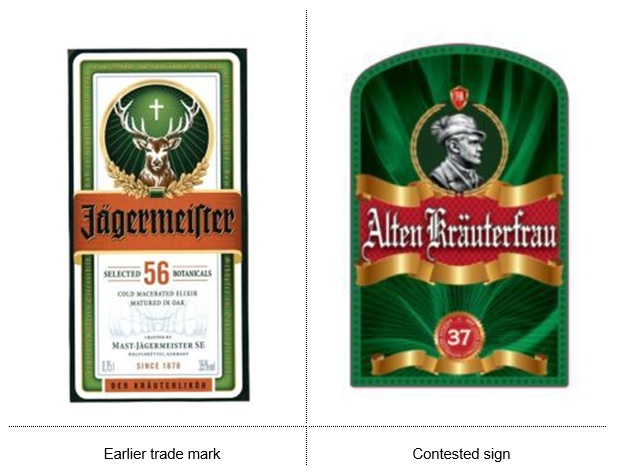
On 24 September 2025, the EUIPO Board of Appeal issued an interesting decision regarding the ground of opposition based on the earlier mark’s reputation (Article 8(5) EUTMR). For the following signs, the EUIPO upheld the opposition:
- Background
The opposition against “Alten Kräuterfrau” was examined a first time by the Opposition Division on 21 December 2021. The owner of “Jägermeister” had based the opposition both on likelihood of confusion between the signs (Article 8(1)(b) EUTMR) and the existence of a reputation of their mark in Germany (Article 8(5) EUTMR). The opposition was originally rejected: although a remote conceptual similarity could be found, the signs were dissimilar. However, the Board of Appeal annulled this first decision and remitted the case back to the Opposition Division, stating that since there was a finding of a remote conceptual similarity between the signs, the Opposition Division should assess the further requirements of Article 8(5) EUTMR. On 3 January 2025, the Opposition division re-examined the case and this time decided to uphold the opposition on the ground that “Alten Kräuterfrau” would take unfair advantage of “Jägermeister”’s reputation.
- The decision
The Board of Appeal confirmed the decision of the Opposition Division, with the following reasoning:
- Existence of a reputation
The earlier mark “Jägermeister” possesses a reputation in Germany with regard to herbal spirits. This finding is backed by the provision of material showing that the owner of “Jägermeister”, who has been using the mark for the better part of 90 years, has a market share of 38% in the “Bitter” category in Germany, way ahead of all their competitors: the second largest manufacturer only has a market share of 15%.
- Similarity and existence of a link between the signs
The Board agreed with the Opposition Division in finding that there was no visual and phonetic similarity between the signs, but that a remote conceptual similarity exists. This is due to part of the German public associating both signs with hunting: some will interpret the depicted male human head in the contested sign as that of a hunter, while the deer head shown in the older sign along with the term “Jägermeister” (translating to “master hunter”) evokes the hunt.
While only remote, this conceptual similarity is enough to warrant the application of Article 8(5) EUTMR. Combined with the earlier mark’s high degree of reputation and the resemblances in the overall arrangements of both signs (such as the use of the gothic font and similar colours), this creates an association between the signs.
- Risk of injury
The fact that both signs are used on identical products targeting the same consumers and in the same channels makes it clear that “Alten Kräuterfrau” could profit from the attractiveness of “Jägermeister”. Consumers would easily believe the “Alten Kräuterfrau” products to be of the same quality as the “Jägermeister” products. Thus, the goodwill of “Jägermeister”, obtained through years of demonstrated efforts, would unduly be transferred to another undertaking.
- Absence of due cause for use of “Alten Kräuterfrau”
The applicant may escape the opposition if there is “due cause” for them to use the contested sign. Here, the applicant argued that the younger sign merely adopted the appearance of a label for a typical German bitter. The Board found it unconvincing. Worse: this “traditional German style” was actually… mostly created by “Jägermeister”! This finding relies on the market share and long-standing use of “Jägermeister” for bitters in Germany. Therefore, copying this style cannot be seen as a due cause.
- Comment LexDellmeier
When comparing the signs at hand, it is unlikely that many would believe the products concerned to originate from the same undertaking. Likewise, the idea that part of the German public would associate the “Alten Kräuterfrau” sign with the hunt seems relatively far-fetched.
Nonetheless, this decision illustrates that the smallest possible similarity between signs may be enough to uphold an opposition, as long as the earlier mark enjoys a strong reputation. It is also worth noting that in this instance, the marks were applied to identical goods, and this circumstance was explicitly given by the Board as a factor to identify a link between the signs. The decision may have been different if the goods were only similar.
Overall, trademark owners investing heavily in their brand will be pleased to see that the EUIPO favours such undertakings and rewards businesses that carefully grow and manage a good reputation for their products. In the specific field of German herbals, competitors will definitely think twice before trying to ride on the coattails of “Jägermeister” again.
Protecting Craft and Industrial Products: The EU’s New Geographical Indication (GI) Framework Effective December 2025
It may not seem obvious, but “Parma ham“ and “Champagne” share several important similarities. On the one hand, both are agricultural products. On the other hand, they are geographical indications. The latter can be protected legally as “Protected Designations of Origin” (PDOs) thanks to Regulation (EU) 2024/1143, which provides EU-wide protection of Geographical Indications for agricultural products, wines and spirits.
In contrast, there has been so far no protection for Geographical Indications for craft and industrial products on an EU-wide basis. This is set to change from December 1st, 2025, with Regulation (EU) 2023/2411, which provides for the protection of geographical indications for craft and industrial products at EU level.

Cosmetics vs Pharmaceuticals – Similar Goods?
The similarity of goods and services is always a decisive issue when it comes to trademark collision and infringement. Proceeding against an alleged trademark infringer requires not only the mark being identical or similar to a registered trademark, but also the goods and services need to be identical or similar. Not always it is clear whether or not there actually is sufficient similarity to establish trademark infringement. Further, the different decision-making bodies in the EU (and the national offices and courts as well) do not always take the same approach or come to the same conclusions. The EUIPO’s Boards of Appeal took a closer look at how similarity between “cosmetics” in Class 3 and “pharmaceuticals” in Class 5 – two classes, often opposing each other – are being treated at EU level and we would like to briefly summarize the findings to give you a better understanding of the approach(es).
(Source: Shutterstock, ID: 2294393873)
- Legal Background
EU law provides that
- a trademark application shall not be registered if
- there exists a likelihood of confusion between the application and an earlier trademark based on
- an identity / similarity in the marks and
- an identity / similarity in the goods and services for which both marks claim protection [Article 8(1)(b) EUTMR];
- goods and services are not automatically similar just because they fall into the same class of the Nice Classification;
- good and services are not automatically dissimilar just because they appear in different classes of the Nice Classification. [Article 33(7) EUTMR]
Furthermore, it is settled case law that
- in assessing the similarity of goods or services, all relevant factors relating to those goods and services need be taken into account [see EU Court of Justice in C-39/97 – CANON], inter alia
- their nature,
- their intended purpose,
- their method of use,
- whether they are in competition with each other or are complementary,
- their distribution channels,
- market practice and the usual commercial origin of the goods or services concerned, as perceived by the relevant public.
- before comparing any goods and services, it is necessary to define the scope of the particular category or item of goods or services in the relevant class of the Nice Classification. This is done by interpreting the terms used in the list of goods and services literally, taking into account their natural and usual meaning (dictionaries, understanding from a commercial perspective) as well as general considerations of the Nice Classification, its Explanatory Notes and definitions in other relevant EU regulatory acts.
For several years, it has been a declared aim of the EUIPO’s Boards of Appeal to provide guidance in EU case law, to enhance the consistency of decision-making practice in the EU and to improve the predictability of decisions and legal certainty in general. Regularly, decisions of the EU Court of Justice, the General Court and the Boards of Appeal are analyzed and discussed as to relevant case-law and trends on the topic.
The result is being made available to the staff of the Boards of Appeal and the public, but it is important to stress that it does not have any binding effect.
- Pharmaceuticals vs Cosmetics
In one of its latest publications, the Boards of Appeal focused on the comparison between “pharmaceuticals” in the class heading of Class 5 and “non-medicated cosmetics and toiletry preparations” in the class heading of Class 3 of the Nice Classification (see Similarity between pharmaceuticals and cosmetics).
After comparing relevant case law, the following conclusions were drawn:
- General category pharmaceuticals in Class 5 versus the general category cosmetics or specific cosmetics in Class 3 (except perfumery, essential oils)
- Consistent case law confirming that the goods are not dissimilar
- Specific degree of similarity treated differently (in decisions)
- General trend:
- General Court: mostly low degree of similarity
- Boards of Appeal: low to average degree of similarity
- PRACTICAL ADVICE to argue average degree of similarity:
- Show overlap in purpose, distribution channels, end consumers, method of use and commercial origin and
- prove that pharmaceuticals and cosmetics have a common commercial origin (manufactured by the same undertakings and/or sold under the same brand)
- Pharmaceuticals with specific therapeutic indications for the treatment of the external part of the body in Class 5 versus the general category cosmetics or specific cosmetics in Class 3 (except perfumery, essential oils)
- General trend: deemed similar to an average degree considering an overlap in purpose, end users, method of use, distribution channels and commercial origin
- Pharmaceuticals with specific therapeutic indication other than for the treatment of the external part of the body in Class 5 versus the general category cosmetics or specific cosmetics in Class 3
- Consistent case law confirming dissimilarity
- Pharmaceuticals in Class 5 versus perfumery in Class 3
- Consistent case law confirming dissimilarity
- Reasons: no overlap in purpose, distribution channels and commercial origin
- BUT: occasional findings of a low degree of similarity between pharmaceuticals in Class 5 and deodorants / essential oils in Class 3 (see specific case law in report mentioned above)
While facts and arguments will still need to be discussed in each individual case, the cited report of the Boards of Appeal gives a good understanding of the general approach of the EUIPO and the European Courts as regards similarity of certain items in Classes 3 and 5. We strongly recommend reviewing the report (see Similarity between pharmaceuticals and cosmetics) as it contains a lot of references to case law with further explanations and reasoning which can be used for your own argumentation.
Also, if you would like to discuss the similarity of goods and services in specific cases, you are always welcome to contact us either by phone at +49 89 55 879 870 or by email to info@lexdellmeier.com