

Given the notoriety of McDonald´s and their products, it is hard to imagine anyone would challenge their entitlement to the “Mac” and “Mc” prefixes. However, it was only recently that the European General Court (the EGC) confirmed in its decision T‑518/13 dated 5 July 2016 that the contested prefixes are reserved for McDonald´s in the food industry.
Background of the case
In 2010, the Singaporean company Future Enterprises Pte Ltd was granted registration of the wordmark “MACCOFFEE” by European Office for Intellectual Property (EUIPO), under the registration number 007307382. On 13 August 2010 McDonald´s International filed for cancellation, claiming that Future Enterprises is taking unfair advantage of the popularity of the McDonald´s brand and the reputation of the earlier wordmark ‘McDONALD’S (EUTM no. 000062497). Also, a plethora of other “Mc” or “Mac” wordmarks, naming different McDonald´s products (Big Mac, McChicken, McCafe, PitaMac…), should not be disregarded. The Cancellation Division decided in favor of McDonalds, stating that the signs are somewhat similar. However, due to a long-lasting use and high reputation of the “Mac” trademarks, it is likely that the consumers will be led into confusion, thinking that “MACCOFFEE” is another sub-brand of Mcdonald´s.
Future Enterprises appealed to EUIPO´s Board of Appeal. They stated that McDonalds does not have a claim over the prefixes, as they are indistinctive and will more likely be connected to a Scottish last name. Also, the two trademarks have coexisted for years and McDonalds does not have a prevailing reputation in the entire EU. The appellant also claimed that the Cancellation Division erred in deeming that the categories of goods and services and the prefixes “Mc” and “Mac” were similar. Finally, trademarks like “PITA MAC” or “BIG MAC” do not belong to the same group of marks as the “Mc” products.
With their decision of 13 June 2013 (case no. R 1178/2012-1), the Board of Appeal stated that the signs are low in visual, but higher in conceptual and aural similarities, and might cause confusion among customers. In question was also the protectability of the whole “Mc” family of products. The Board deemed that McDonalds did prove genuine use of multiple compatible trademarks and the consumers would connect “MACCOFFEE” to the “McFamily”. When it came to distinctiveness of the “Mc” prefix, it was true that the Scottish and English population might consider it as a prefix of a last name. However, when speaking of the respective goods and services, “McDONALD´S” enjoys a very high reputation and is highly distinctive. Considering their market share and turnover (around 3 billion dollars worldwide), the intensity, geographical extent, duration of its use and investments in promotional activities, the Board decided McDonalds enjoys reputation in a substantial part of the EU territory. Therefore, it is not unreasonable to think that Future Enterprises would benefit from the other trademark, considering they target the same relevant public.
Future Enterprises appealed once again, and took the case to the EGC.
Decision of the Court
The EGC decided on the case on 5 July 2016. The first claim the judges tackled was on the similarity of the trademarks. Future Enterprises claimed that the Board of Appeal misjudged the importance of visual similarity in the food industry. They repeated the connection of the prefixes with the Scottish name and added that the American public would perceive it as slang for addressing a stranger in a friendly manner. However, they did not contest the likelihood of confusion. The EGC accepted the claim that there was no visual similarity, not even on a lower level. However, it agreed with the Board of Appeal´s judgement that there was a phonetic and conceptual similarity, as well as an overall similarity.
The second point they had to decide on was the entire “McFamily”. They cited case law and stated that several marks could be considered as a family if they possess common characteristics like having the same distinctive element with the addition of a graphic or word element differentiating them from one another, or when they are characterized by the repetition of a single prefix or suffix taken from an original mark. Upon examining provided evidence, they decided that there was sufficient proof of use of the other “Mc” and “MAC” trademarks in the fast food industry. Also, McDonald´s ensured that the prefix had its own distinctive character. Therefore, the Board of Appeal did not err in concluding that the conditions for a family of trademarks were fulfilled.
Next, the similarity of the categories of goods and services was weighed. “MACCOFFEE” was registered for “foodstuffs and beverages”, and “McDONALD´S” for “fast food services”. These categories are highly compatible, and should be considered as similar.
Finally, the EGC had to decide whether Future Enterprises was free-riding on McDonald´s reputation. Future Enterprises´ claims that the signs have peacefully co-exited should be disregarded, as the current lawsuit was the exact proof that McDonald´s was not content with their co-existence. Multiple studies have shown the reputation of the “Mc” and “MAC” products, and the strength of the link of the prefixes with the goods. Therefore, consumers´ logical train of thought would be that “MACCOFFEE” belonged to McDonald´s International.
On presented grounds, the EGC dismissed the action in its entirety and ruled in favor of McDonalds, securing their dibs on the “Mc” and “MAC” prefixes.
On April 24, 2016 the European Union Intellectual Property Office (EUIPO) published the report on infringements of protected geographical indications (GIs) for agricultural products in the EU. A GI is an indication (usually a name) used on products having a specific geographical origin and possessing a given quality, reputation or other characteristic that is essentially attributable to that origin. The study was conducted from 2012 to 2015, with the aim to establish the size and value of the GI market in the EU, as well as the impact of infringements on EU customers. It included all protected GIs, coming from EU Member States and third counties, protected through registration or by an international agreement.
Size and value of the EU GI product market
The EUIPO database contains more than 4,800 protected GIs. Consumption of these goods in 2014 amounted to 48 billion EUR. The biggest consumers are also the biggest producers, namely France, Germany, Italy and the UK.
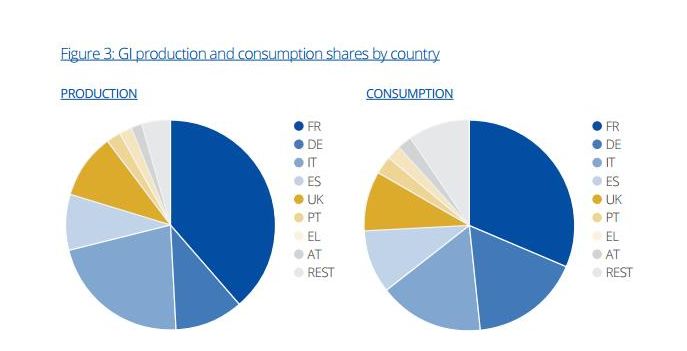
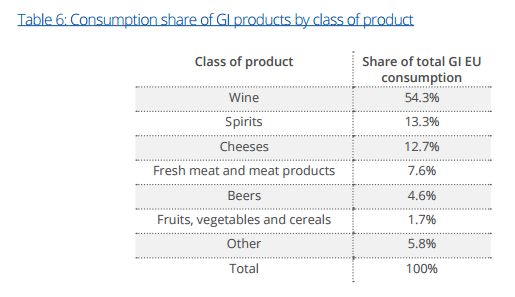
When observing the types of goods consumed, some light is shed why France has such a big role in the GI sector. The most consumed products are wine, spirits and cheese, all of which are considered as French delicacies.
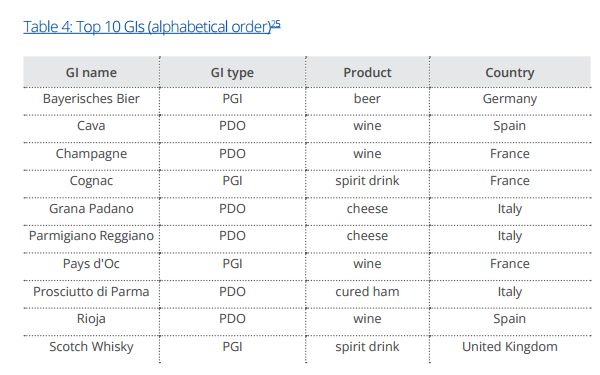
Almost one third of the GIs sold derive from ten leading products.
96% of consumed goods originated from the EU and 68% came from the same country where consumed. Only a small number of third country-produced products hold significance in the EU, such as Café de Colombia and Mexican Tequila, and their infringements are not as common as they are with the EU products. When it comes to exports, France, Italy and the UK are considered to be the European leaders of the group.
Infringements and their impact on EU customers
Studies have shown that agricultural GI products contribute to rural development. Also, they enhance smaller producers´ reputations, increasing their competence to compete with larger mass-producers. Next, it was proven that PDO and PGI logos are well recognized among EU consumers, inciting them to pay a higher price for the product. The occurring problem was the fragility of the reputation of GIs. One producer selling a lower-quality product led to a domino effect, with the consumer doubting all of his competitors too. Some cases have shown that consumers put more emphasis on supporting the local economy and promoting the authenticity of the product, than they do on the quality of the good.
Researching around 82% of the EU GI market, the results show that 9% of the market was covered by infringing goods, amounting to 4.3 billion EUR. More than half of that (4.8% of the total market) was done by unknowing customers, paying premium price for a product they believed to be a GI product. It is estimated that customers were at a loss of 2.3 billion EUR in total.
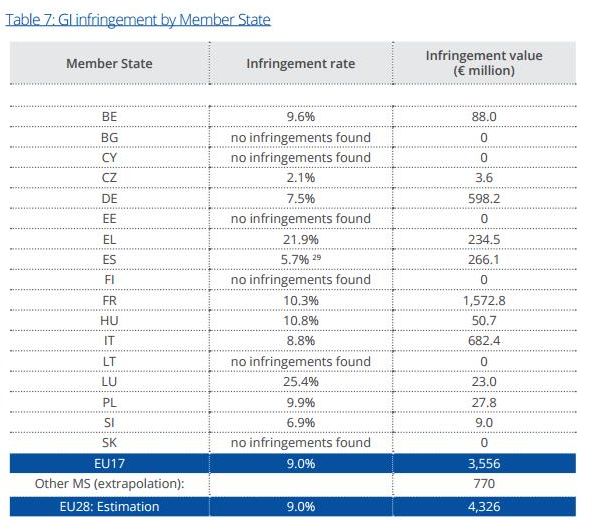
It is no surprise that the most consumed products are also the most common subjects of infringements. The biggest loss, more than 1.3 million EUR, is in found in the wine industry, although it is on the lower side of the spectrum when it comes to infringement rates. Combined with spirits, together they account for nearly 80% of total consumer loss.
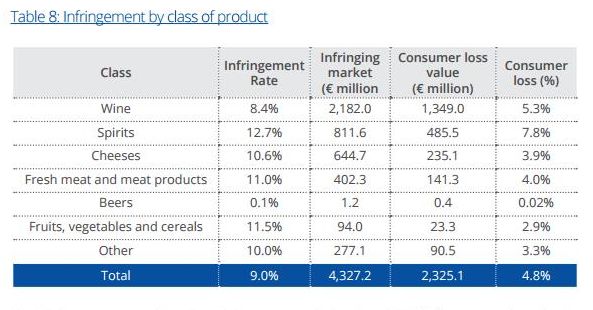
The study included false or misleading use of the protected GI and marketing of product not originating from the indicated place of origin. Most infringements were imitations with 42%, continued by misleading GI labels with 38%, and deception in product specifications (or differently put, the lack of quality promised) with 21% of total infringements.
Conclusions
EUIPO´s report is a valiant first attempt to grasp the extent of GI infringements in the EU. The results have shown to be less than satisfactory, and the next steps might be the expansion of the study to a global level, followed by the appropriate response by the European Union.
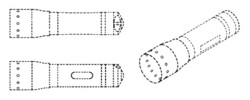
In line with a recent Louboutin decision, the Swiss Court on 13 May 2016 decided on another purely decorative element filed as a position trademark. This time, German flashlights were in question, and the circular position of the holes on their rim.
Background of the case
Zweibrüder Optoelectronics GmbH is a German manufacturer of flashlights and headlights. They were of the opinion that the special positioning of holes on their “LED LENSER” flashlight line was unusual enough to be granted trademark protection. They successfully obtained protection in Germany (TM no. DE 30077125) and were looking to elevate the protection of their position trademark to an international level. However, when trying to register the trademark in Switzerland (TMA no: IR 776 691), they were rejected by the Swiss Intellectual Property Office, for reasons of technical necessity for the product and the lack of distinctiveness of the trademark. This led to a lawsuit on 17 April 2014, but the Administrative Court stated that the simple circular arrangement of eight holes is not enough to be the indication of origin, but an esthetic feature of the product. Still believing in their trademark, Zweibrüder appealed to the Swiss Federal Administrative Court.
Decision of the Court
The Swiss Federal Administrative Court rendered its decision on 13 May 2016 (case B-2894/2014). Zweibrüder claimed that the holes are unusual and distinctive for this product. They add no technical value to the good, and in fact, allow light to escape through the holes. They never claimed acquired distinctiveness. The Swiss Federal Court agreed on all of their claims, except for the crucial one: whether the holes gave distinctiveness or were there only there for decoration. The Court´s view on the protectability of position marks is on the narrower side of the scale. It is of the opinion that distinction can be gained by positioning an element of the trademark on an uncommon or unexpected place. However, if the element is a part of the product´s shape, it should be considered as a shape mark, and not a position one. Next, the court stated when there are multiple possibly differentiating elements, the weight shifts to the overall impression of the product. In this case, the holes are positioned in a simple circle and there is nothing indicating that the consumer would identify the product simply by looking at these elements. Therefore, the previous decisions are upheld.
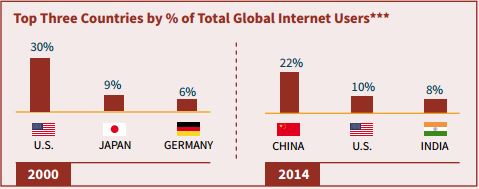
We all know that the Internet is everywhere and that our life without has become unimaginable. We also know that its popularity soaring by the minute. However, the rates of its expansion might be even more than anyone could have imagined. If the number of Internet users continues to rocket at current rate, it is predicted to have 5 billion users by 2020. The expected population by that time is 7.8 billion. Therefore, 64% of population in the world will be connected! This is especially shocking in comparison to the numbers from 2014, when (only) 40% of citizens were Internet users.
In the past fifteen years, not only have the numbers skyrocketed, China has taken over the lead in the highest number of Internet users. It clearly established its dominance, doubling the numbers of the next-in-line USA.
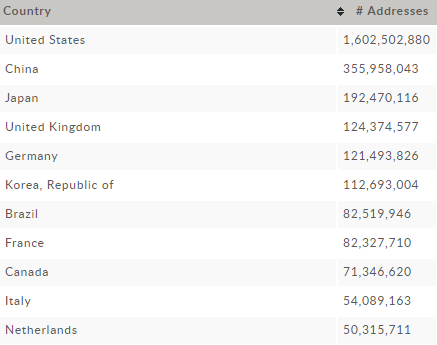
However, when looking at the numbers for registered internet domains, the largest proportion of them still come from the USA.
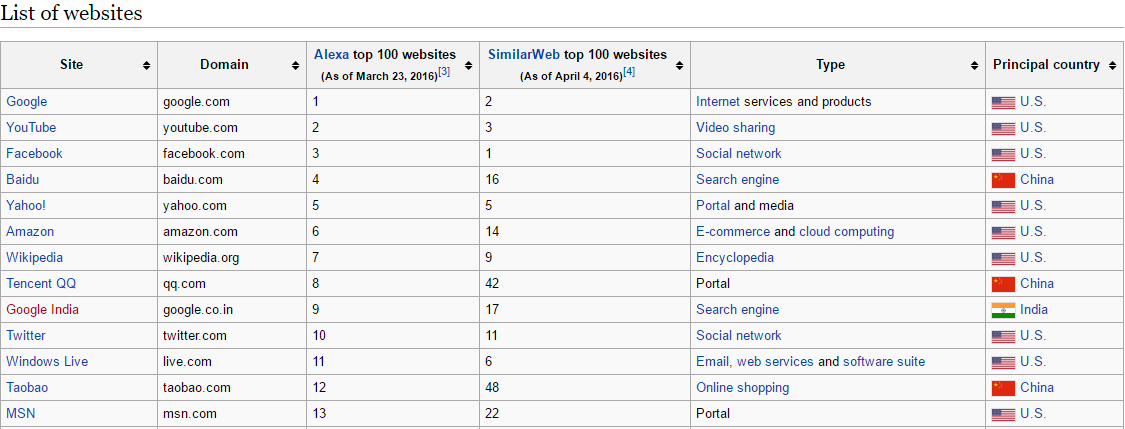
The most visited Internet sites are no surprise. Big search engines like Google, Baidu and Yahoo! are accompanied by social media giant Facebook and Google´s video sharing website Youtube.
What are TLDs
The easiest way to define a top level domain (TLD) is saying it is the last thing we type when entering an Internet address. It is the ending, the last part behind the dot.
There are six types of TLDs: infrastructure TLD (ARPA, reserved for technical infrastructure purposes), generic TLD (gTLD), restricted generic TLD (grTLD, generic, but require proof of eligibility set for each grTLD individually), sponsored TLD (sTLDa, specializedTLD representing a specific community, like .edu for universities or .gov for government), country code TLD (ccTLD, specific for each country, like .de for Germany or .fr for France) and test TLD (tTLD, reserved for testing a domain). The most popular TLDs are generic, followed by country code TLDs.
The absolute winner of this popularity contest is the .com domain. In its beginnings reserved for commercial purposes, nowadays it is available to everyone. In fact, its overwhelming popularity makes it very alluring for non-commercial entities and there has been a notable rise of such registrations in the past years.
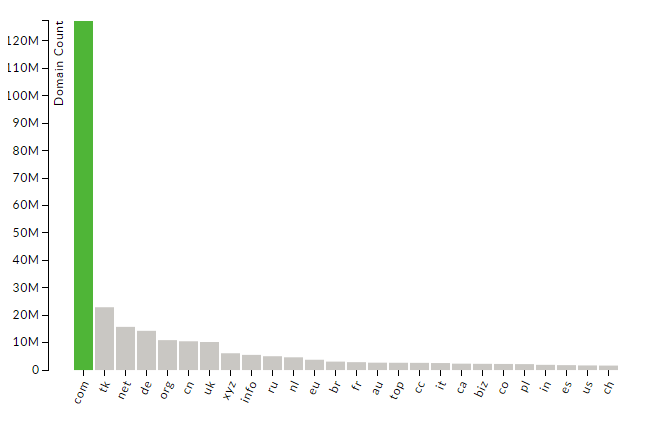
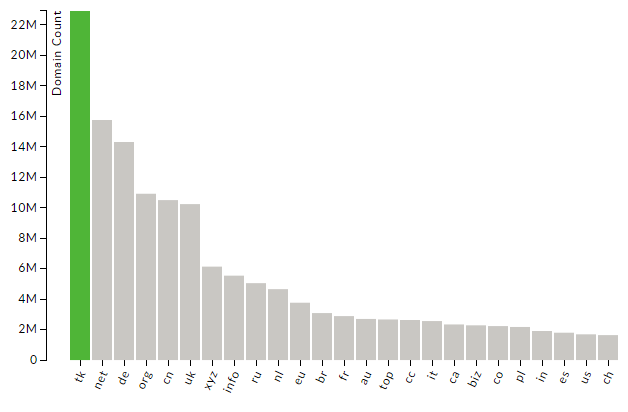
The odd (and problematic!) thing is that data shows that the domain following .com in popularity is .tk, which is the ccTLD for Tokelau, a small island in the Pacific, territory of New Zealand. In 2006 it was reported that 95% of phishing and spamming scams are conducted through .tk domain. Newer reports show that these numbers have reduced, although there is still obviously room for improvement.
gTLD
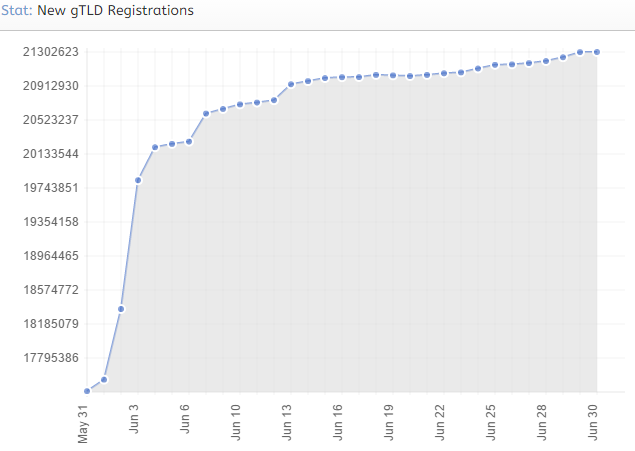
gTLDs are the most popular types of top level domains. Strengthening in numbers daily, they are now counting over 21 302 700 registered domains.
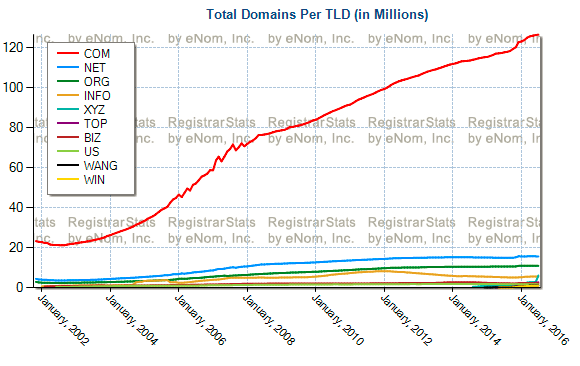
As previously mentioned, out of all the gTLDs, the .com domain is favored the most. With its 107 043 593 registered domains, it is largely predominant to other gTLDs, with no decline in sight.
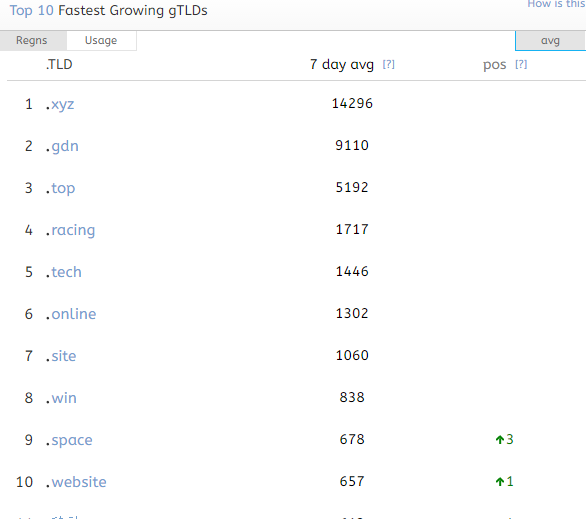
The biggest average rise in the number of registrations has been noted with the .xyz gTLD. The list is comprised out of “smaller” gTLDs, with a higher growth perspective.
ccTLD
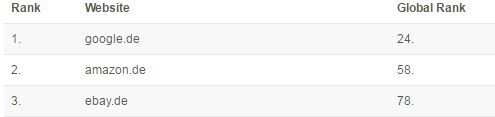
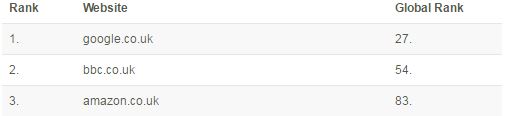
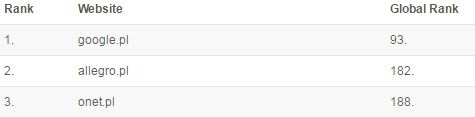
It is of little surprise that consumers find ccTLDs more trustworthy than gTLDs, especially if coming from their own country (95% trust level). In Europe, the largest proportion of ccTLDs comes from Germany (.de), followed by the UK (.co.uk) and Poland (pl).
Germany
The UK
Poland
On 23 June 2016, the referendum held in the UK tailored history and after 43 years of membership, a small majority of UK citizens decided to leave the EU. As one of the leading countries, with the second largest nominal GDP in the EU, it is safe to say things will now have to notably change. However, it should be mentioned that the switch will not come overnight, there are negotiations to be held and conditions to be met, and the real exit is not expected for a couple more years.
First thing to know is that EU trademark and design systems will no longer be applicable in the UK. Likewise, EU Courts will no longer be an option for the UK citizens.
UK-based lawyers will not be able to represent their clients in front of the EUIPO. They ought to expect a drop in their workload, because companies might change to attorneys eligible for EU-wide representation. In case the UK joins the European Economic Area (EEA), there is a possibility of representation, but this is very uncertain at this early stage.
Current trademark owners might have to reapply for UK national trademark via UK IPO or WIPO. It is probable that there will be a transitional period for UK trademark owners, but there are several possible scenarios that could play out. Whether there will be a conversion process or will UK decide to keep the status quo, it is currently impossible to tell.
As a result, all of this is predicted to affect UK business. The process of registration will now be more complex and lengthier, and more displeasing for both the UK-based and the international companies. Therefore, it a drop in economy is expected.
For more detailed information, please visit http://www.itma.org.uk/membership/resources/eu_referendum.
There has been another round in the legal arena for Rubik´s cube, and this one might be a sign of a shift of powers. So far, all EUIPO´s and EGC´s decision were in favor of protecting the cube, but after the Advocate General´s unfavorable opinion towards this practice, it seems plausible that the European Court of Justice might agree with him.
Background of the case
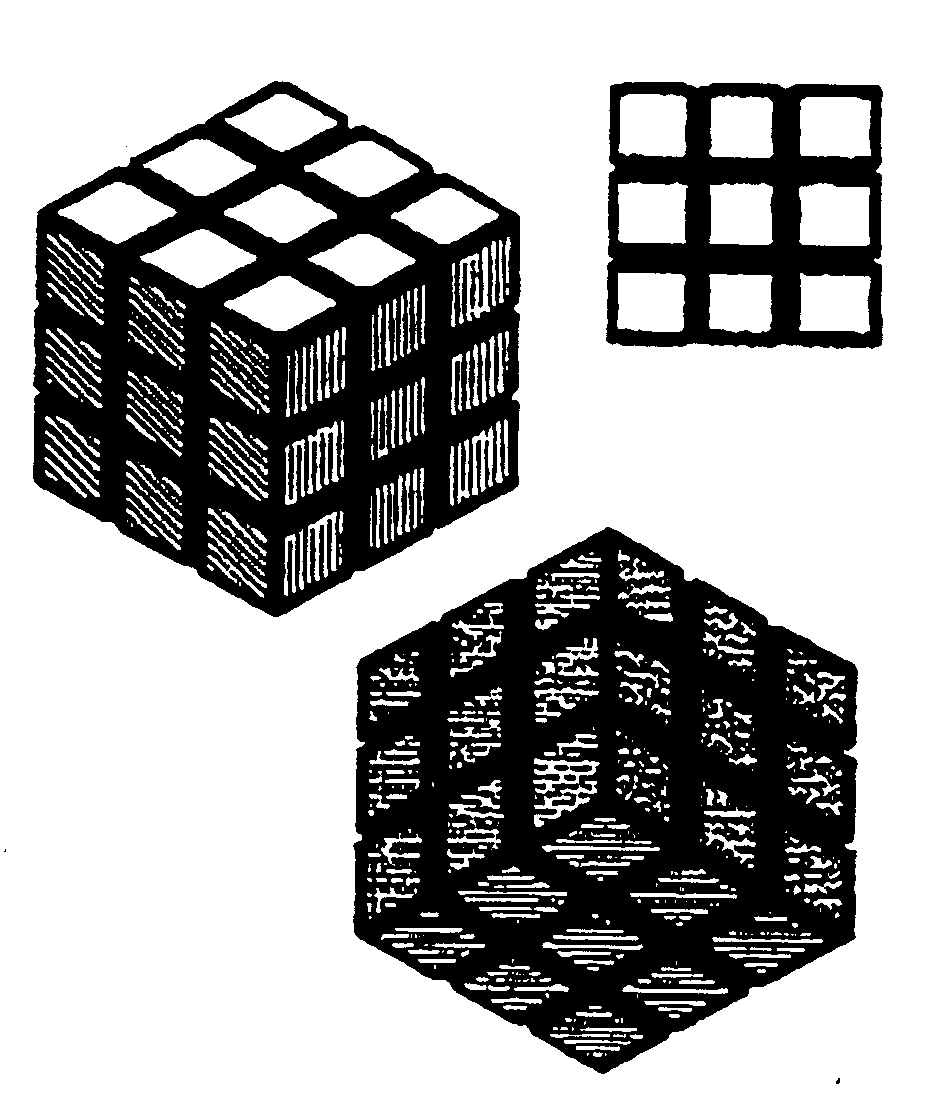
The British company Seven Towns and German manufacturer Simba Toys have been disputing since 1996 whether the frustrating-yet-beloved Rubik´s cube is eligible for trademark protection. More precisely, is the three-dimensional shape of the cube (EUTM no. 162784) eligible for patent registration solely or for 3D trademark registration. Simba argued that the shape was a technical solution and purely functional. The Cancellation Division, Board of Appeal and the General Court of the European Union (the EGC) all agreed this claim was not true. The EGC (case T‑450/09) stated that the graphical representation of the shape of the cube and its grid structure did not imply any technical solutions. The background behind the rotation of the cube is not important for trademark protection. One might think this ruling was “game over” for Simba, but after appealing to the CJEU, Simba´s position just might be changing.
For a more detailed summary of the case, please visit our previous blog post.
Opinion of the Advocate General and future actions
The case (C-30/15 P) is yet to be decided by the CJEU. However, AG Szpunar handed in his opinion on 25 May 2016. He states that EGC´s line of thinking about the link between functionality and the graphic representation of a trademark might harm the public interest. Also, when it comes to protecting a shape mark, a broader picture should be observed and other factors taken into consideration. The AG backed his claims with previous case law, namely Pi Design (Case T-416/10) and Lego (Case C-48/09). The AG is of the opinion that the rotation of the grid is the epitome of its function, and that, beyond that, the cube has no decorative elements. Therefore, the decision of the EGC ought to be reconsidered. The final teaser AG Szpunar gave was that the CJEU has already disregarded EGC´s theory on restriction of functionality analysis just to the trademark´s graphic representation. It is yet to be seen if this really was an indication of CJEU´s line of thought.
The two Merck pharmaceutical magnates have shared one name for decades. However, their coexistence has become anything but peaceful, with mutual lawsuits filed all over Europe, and not without good reason. The namesakes managed to confuse everyone, including Facebook, and it is safe to say it is time for a new solution of their problem. Even the European Court of Justice (ECJ) got involved, as their case pointed a few questionable areas of the European Union Trademark Regulation.


Background of the case
Merck was established 1668 in Germany. After the World War II the company decided to split into two parts: Merck KGaA or Merck Global and Merck US. Predicting that the same name might present a problem, the parties entered an agreement where Merck US was allowed to use their name in the US and Canada, while Merck Global kept the rights to the name towards the rest of the world. However, Merck US could still operate under their full name of Merck Sharp & Dohme Corp (MSD) or with the addition of a geographical indication (like Merck US). The agreement was concluded in 1955 and renewed in 1970. Unfortunately, the 1970´s agreement could not predict the massive globalization or the Internet. Therefore, when it came to large numbers of UK citizens visiting merck.com (belonging to MSD), the problem reappeared. The confusion did not stop there, as Facebook accidentally allowed for both companies to share one Facebook domain. Another thing that did not help the situation was MSD´s new campaign, starring the word “Merck” alone, without the necessary accompaniments. And finally, Merck Germany underwent a brand makeover, calling themselves the “Originals” and adding fuel to the fire. This escalated to crossfire of lawsuits all over Europe, with both parties claiming breach of the other. On 15 January 2016 the English Court decided that MSD was overstepping the boundaries, as parts of their website were clearly intended for British customers (decision HC 13 B00955).
Future of the case
The Merck case reached a new level on 25 April 2016, when the Regional Court of Hamburg (Landgericht Hamburg) asked the CJEU for a preliminary opinion on seven questions (case C-231/16). The questions evolve around Article 109(1(a)), titled “Simultaneous and successive civil actions on the basis of EU trademarks and national trade marks”. Specifically, the article says:
“Where actions for infringement involving the same cause of action and between the same parties are brought in the courts of different Member States, one seized on the basis of a EU trade mark and the other seized on the basis of a national trade mark:
(a) the court other than the court first seized shall of its own motion decline jurisdiction in favour of that court where the trademarks concerned are identical and valid for identical goods or services. The court which would be required to decline jurisdiction may stay its proceedings if the jurisdiction of the other court is contested;”
Firstly, the Hamburg Court asked what does the EU entail? Is a virtual “territory” the same as the material? If there are two parties operating under the same domain, does it equal to them operating on the same territory?
Secondly, what is the scope of declining jurisdiction? When an application for a national trademark was prior to the European one, is the second court supposed to decline jurisdiction only for the territory of the national trademark or does the domestic court get to decide for the rest of the EU too?
Thirdly, what is the meaning of action withdrawal? If the plaintiff withdraws the national lawsuit, does it preclude declining the jurisdiction of the second court?
Finally, in the case where only some of the registered classes of the Nice Classification are identical, which Court gets jurisdiction regarding the rest?
Europe is definitely caught up in football fever. Not even the European General Court (EGC) was spared. Rendering their decision on the case Cule v Kule, they decided on the link between a football club and its fans, at least when it comes to proving genuine use of a trademark.
Background of the case
KULE LLC is an American designing company owned by Nikki Kule, famous for their striped shirts collection. They protected the word mark “KULE” on 22 April 2011 in front of the European Union Intellectual Property Office (TM no: 009917097). They sought protection for classes 14, 18 and 25, mainly regarding to fashion industry. However, Fútbol Club Barcelona opposed the mark (case 001926917), basing it on their Spanish marks for the word “CULE” (TM nos: 2 716 946, 1 021 594, 1 021 596). Cule is a famous nickname for a FC Barcelona fan. A recognizable term all over Europe, FC Barcelona used this fact as an additional ground for opposition, saying that as a well-known mark, no goods or services could use this name. To prove the use of the trademark they submitted a dictionary entry backing up their claims of the term being used in relation to the football club. Also, they added various internet print-outs. However, the Opposition Division did not find this sufficient evidence, and the opposition was rejected. Next, FC Barcelona filed an appeal to EUIPO´s Board of Appeal (case R2375/2013-4), also with a negative outcome.
Decision of the Court
The case continued on in front of the EGC, which decided on it on 16 June 2016 (case T‑614/14). The Court stated that it had to examine the length and frequency of use of the trademark, as well as the ways it was used and commercialized. However, the Court found it problematic that all the proof of use was actually connected to the fans, and not to the club itself. Therefore, the Board of Appeal did not err in its assessment that the submitted evidence does not prove genuine use.
On the final morning of the ECTA Annual Meeting, the first four sessions were all about presenting different points of view on the same topic. One session was on Prior Rights Agreements, introducing the topic from an industry worker’s perspective and a practitioner’s. The parallel session was on Copyrights. The first speaker was Dr. Florian Drücke from German Federation of the Music Industry. He started by admitting that the industry reacted very late to the emerge of the Internet. They did not take it seriously until early 2000, but, after realizing it is a tool that is here to stay, expressly started finding ways to protect copyright online. Their current goal is the development of a sustainable digital market and establishing better offer of legally downloadable goods. However, battling pirate content is proving to be very hard. They are using two methods, “follow the money”, where they are following the money path to the first uploader of the content, and “notice-and-takedown/staydown” strategy, but these fights are taking up a lot of time and effort. The thing that makes it easier is cross-border enforcement and awareness raising initiatives. Although they both still need some refinement, they are proving to be successful in the long run.
Next, we heard about the different debates concerning exceptions and fair use in copyright by Prof. Niklas Bruun. He talked about the WIPO, WTO, EU and US debates and how big of an impact they have on this subject. He summarized by saying the EU uses Berne Convention’s 3-step test and that the author has the exclusive right to authorize reproduction of his work and that the EU Member States decide their own exemptions, while the US approach is inclining towards “fair use” concept.
Finally, we heard about future technology developments and how will legislation and practice have to deal with it. The Internet is now a network including the Internet of people, things and services. Therefore, it is unavoidable, and it is up to us to adjust. All “smart” objects contain a copyrighted software, which is then licensed to the end user. This may be considered as restricting user freedom in the market, and even the courts are in disagreement on this topic. The US Courts find it permissible, while the EU Court does think it is a restriction. The EU Courts have not yet taken (but will soon) a stand towards market dominance that occurs with the network of smart objects. They usually connect with one another, creating a network of compatible products. The next problem we might have to tackle is a smart object as an author of copyrighted work. The famous example the court had to decide on was selfie-taking monkey, but smart object could create works far more sophisticated works than this. Although in concordance that an animal or a machine cannot have copyright, it is debatable if there is a person who is entitled to it and who that person is.
The next two parallel sessions were about filing a global trademark without national objections and IP matters in China. There is a dialogue between the EU and China lasting for over a decade now. This strategy coordination led to many improvements. Some of the current topics discussed are the problems of the 2014 Chinese Trademark Reform (like battling bad faith applications), Patent System amendments, protection of trade secrets, judicial and academic cooperation, and fighting online sale of counterfeit goods. A special problem is the lack of IP Courts in China (only 3 now, all in big cities, but, the problems constantly emerge in the smaller towns and villages). When it comes to the distribution of pirated goods, enforcement has been singled out as the biggest problem. Due to the size of the country, it is very hard to cover all places where fakes are being developed. The European Commission has suggested the “follow the money” approach, but it has not yet marked any success. The biggest problem of the Chinese system still remains its “double track system”. You can choose either the administrative or judicial path for protection, but they do not cooperate. In fact, they tend to deliberately ignore each other.
Talking about the changes in the Chinese trademark system, they can be divided into three categories: procedural, substantial and enforcement changes. Procedural changes include the possibility of registering sound marks (so far, there has not been a single registration), easy e-filing and multiclass applications. However, the latter are not recommended because the possibility of division later is very limited. Also, a good tool in theory are examination notices, which allow for correspondence with the examiner in order to amend the application instead of rejecting it. However, the examiners do not use this because of their huge workload. Further, the right to oppose a trademark is given solely to the owner of prior right and it has to be done within 12 months. If you fail with the opposition, there is no court remedy, and your TM will be deleted automatically. Regarding substantive changes, the most important ones include the definition of use and infringement of a trademark. Also, you can ask for revocation of third party trademark if you can prove the third party knew about your trademark or prove first use, even though you trademark has not yet been registered. From an enforcement standpoint, the penalty has increased to up to five times the illegal turnover and up to 250000 CNY (approximately 35000 EUR). If there are “serious consequences”, the damages triple. A useful tool is that the Court can order a party to disclose account books under the threat of higher damages.
Finally, we received a real example of how the Chinese system works. Thomas Jullien of the Bordeaux Wine Council told us the story of registering a collective mark in China, and all the obstacles they encountered with Chinese administration. In the end, they were successful, but it took a lot of work and strategizing. The future for them is obtaining the status of a well-known mark, which also does not come very easily.
The next session was a very inspiring and modern outlook on all the changes technology brings and the roles of lawyers in it. Titling his presentation “Rogue Waves and Crosswinds: The past and the future of intangible assets in a digital, networked world”, Mr. Mladen Vukmir said that this is the time we are redefining sovereignty. Every technology changes the definition of copyright, and to truly innovate in our profession means more than just to adapt to the change. If we do not embrace it, we cannot control it. The recent movement goes towards the maxim “Authenticity is invaluable, originality is non-existent”. There are not many new things to be discovered, but putting your own mark on someone else’s idea or using it as a starting point, this is where copyright protection is headed towards. How should IP practitioners swim in these new waters? It is important to remember that the law does not come first, people and innovation come first, and law should serve them, and not the other way around.
The closing session of the Meeting was an update on current case law. First from Mr. Justice Arnold, Judge of the Chancery Division of the High Court England and Wales. Reassuring us that Britain’s recent decision to leave the EU will not have an impact for the Court for some time to come, he gave us an overview of case law concerning condition six, Article 9 of the Trademark Regulation. Mr. Christoph Bartos gave us a low-down on EUIPO’ s Board of Appeal’s Case Law, and Mr. Fabio Angelini talked about the strange practice and the “fuzzy logic” of the CJEU when deciding in the case Iron & Smith kft v Unilever NV (case C-125/14).
These were the final words from Dubrovnik. Next year the Meeting will be held in Budapest, Hungary, and there is no doubt it will be just as amazing of an experience as it was this year.
The day started with welcome speeches given by ECTA’s President, Mr. Mueller, Dubrovnik’s Deputy Mayor Mr. Raguž, Mrs. Kauterovac, Director General of Croatian IPO and the organizing Committee, led by Mr. Vukmir.
Next, the keynote speech gave us a perspective from a different, entrepreneurial point of view. Mr. Emil Tedeschi, one of the most successful entrepreneurs in Croatia talked about the growth of his business empire and the importance of brands and trademarks. He said that the competition is so enormous that even if titans like Nestle ceased to exist, it would not make much difference in the world. So how did a small company from Croatia that started with tissue papers grow into a regional distributor of companies like Mars, Johnson & Johnson, Duracell and Wrigley’s? The first commandment is to know your market and competitors, and do not fight lost battles. There is no shame in quitting, if your competition is too strong and you would finally end up at a loss. Connected, it is very important to know what distinguishes you from the others. It can be competitive production prices or uniqueness of your product, but the focus should be on that characteristic. And finally, branding is key. It is not just about the quality of the product itself, it is about the whole package, making your product as recognizable as it can be. An example was Cedevita, a famous Croatian vitamin drink. As it was considered as an old-fashioned and outdated product and everyone crossed it out as a thing of the past. Mr. Tedeschi rebranded it and created and patented a special unique bottle cap, making the old brand stronger than ever.
Next, we got an overview of novelties in IP world. Firstly, EUIPO’s Executive Director Mr. Campinos gave us an overview of EUIPO’s work and latest changes. It is fascinating to know that 35% of EU workers work in the IP-strong industries, and this business makes for 90% of EU export. Also, we got a short report on results of researches conducted in cooperation with other international bodies. Currently, EUIPO is facing a noticeable rise in applications, which counts 11% in 2015, and 15% in the first months of 2016. What EUIPO is hoping to achieve is better quality service with e-filing, fast track applications and constant updating of their Guidelines for their employees. Also they are hoping to continue nursing current collaborations and working on European Patent, Digital Market, Geographical Indications…
After this, we got an update on EUTM Report Implementation by Dr. Michael Koenig. He talked about secondary legislation and transposing the Package into national laws. It will not end there, implementation workshops with Member States will also be held. He then talked about EU IP policy beyond Trademark Reform: evaluation of Design legislation, Geographical Indications for non-agricultural products, SME package (mostly focusing on patents) and the IP Chapter of the Single Market Strategy.
Then, it was WIPO’s turn. Mrs. Valdimarsdòttir talked about news considering Madid and Hague Agreements. The main point made about the Madrid Agreement was its constant growth in accession. Every year they get new signatories and the next focus will be on Latin America. Also, they are marking a staggering growth in application numbers: 25% in the USA and EU, 30% in Australia and 40% in India. On the gloomier note, Madrid International Registrations Information System (MIRIS) was mentioned. Although it started with a bang, there are a few issues with the system to work on. The biggest novelty with the Hague System was that US and Japan joined in 2015, and it has been proven that WIPO’s system is easier and faster than the domestic ones.
Finally, Marc van Wesemael of EURID gave us low-down on latest efforts concerning .eu domain. He introduced us to the marvelous term BHAG (big, hairy, audacious goal) and said that theirs was is full trustworthiness. Luckily, they have more than a few good ideas on how to achieve this. Firstly, correct registration is crucial. Currently, they have a manual check of suspicious registrations, but an automatized one would be a lot more efficient, and they are working on algorithms to achieve it. Also, they have an idea of collecting review data from various sites and creating a general “trust score”. They are planning more collaborations, just like the latest one, created on 23. June 2016 with EUIPO. From now on, when a registered domain is similar to an existing one, the information will be directly sent to EUIPO, because of the likeliness of a parallel trademark infringement.
The rest of the day was reserved for European Trade Mark Legislative Package. There were presentations on the absolute and relative grounds for refusal by Prof. Dr. Dr. h.c. Annette Kur and Dr. Andreas Renck. There was a lot of talk about the deletion of the requirement of graphical representation, and the common opinion is that, although sound and motion trademarks will benefit from it, other types of trademark will probably not be as impacted as they should have been. Also, position trademarks are continuing to be a prickly topic. Some would argue if they should be a special type of trademark, and if yes, how should they be represented. The other changes in trademark system involve the special relative ground for PDOs and PGIs, mandatory national administrative opposition and cancellation proceedings…
The novelty with filing process is that it now includes the countries of the EEA, not just the EU. When it comes to the examination, the prohibition of voluntary disclaimers is new. Also, third party observations have become more efficient: now they can be expressed at any point of registration process, and even can lead to reopening of the examination.
When talking about company name defense, the new Package specified that only a natural person should never be blocked to register a TM if the trademark equals his name. This presentation tackled intervening rights too. This is relevant for “dormant rights”, which are registered, but unused trademarks. Now, this defense method is allowed for national trademarks too. Changes in this practice will add to legal certainty and put a stop to old strategies, like acquiring an earlier unused trademark.
Final part of the session was on Anti-Counterfeiting and Enforcement. First, Mrs. Sylvie Harding from Chanel talked about storage and destruction costs, followed by Mr. Ninoslav Babić of Croatian Customs Directorate. He explained Croatian Customs’ strategy. It does use EU Guidelines, but trying to be as proactive as possible, with a focus on copyright infringement. He enriched his presentation with their real-life examples and experience. The last speaker of the day was Mrs. Nicole Semjevski of EUIPO, who introduced EDB, Enforcement Database. It is a platform build on TMview and Designview, in order to help enforcement authorities to distinguish original goods from fakes. What makes it different is that it allows manufacturers themselves to upload data on their products.