

LexDellmeier - 2021 Holiday Greetings from the whole IP team here in Munich, Germany.
"Santa Claus is coming to town" is the music you will hear, when you watch our Xmas video card and turn on the sound... but, do you also remember the lyrics of the first line of the song which is: "You better watch out, you better not cry"... REMEMBER, some color marks are regsitered by trademark owners... and even though #colormarks are not simple to apply and register for, you may be eligible, too! Different countries around the world have different rules... it may be worth looking into for you in 2022. In general, color mark protection is possible in Germany at the #gpto and at an EU level at the #euipo
It would be great to read, if color mark protection is possible in your country?! Comments and insights welcome! #LexDellmeier #trademarks
[[{"type":"media","fid":"5371","view_mode":"default","instance_fields":"override"}]]
[[{"type":"media","fid":"5370","view_mode":"default","instance_fields":"override"}]]
HAPPY HALLOWEEN!!!
Anyone who wants to know when and where Halloween originates from should check out the great article the German Patent and Trademark Office (GPTO) published in German and English.
Fact is that Halloween, not really known in Germany for many years, has meanwhile become a million dollar business. As you can imagine, the need for intellectual property rights - trademarks, designs, utility models and patents - therefore has increased. The GPTO has picked some unusual, fun and/or gruesome patents.
It's a fun article to read that we wanted to share with you - Link: https://www.dpma.de/english/our_office/publications/background/halloween/index.html
[[{"type":"media","fid":"5343","view_mode":"default","instance_fields":"override","attributes":{"height":627,"width":1200,"style":"height: 314px; width: 600px;"},"field_file_image_alt_text[und][0][value]":"Halloween","field_file_image_title_text[und][0][value]":"Halloween"}]]
LexDellmeier supports great local charity project “SPENDIERMAß”
[[{"type":"media","fid":"5342","view_mode":"default","instance_fields":"override","attributes":{"height":486,"width":928,"style":"width: 700px; height: 367px;"},"field_file_image_alt_text[und][0][value]":false,"field_file_image_title_text[und][0][value]":false}]]
© Karolin Schech, LexDellmeier
2021 – the second year in the pandemic. The second year in which Oktoberfest and most other festivals in Bavaria are not taking place. For most Bavarians and worldwide “Oktoberfest lovers” this is of course a disaster. The situation is however a catastrophe for those whose income depend on these festivals and thereby support their entire families. The second corona year has paid its toll to these families and threatening their existence.
Anton Kölbl, a local goldsmith with great affinity to Bavarian tradition decided to support these travelling showmen with a creative and lovely idea: the ”Spendiermaß”. This is a small pin in sterling silver or bronze in the form of a Bavarian „Maß“ – a beer mug which holds a whole liter of beer. Anton designed the unique little masterpieces of jewellery in his “Atelier Kölbl” (check it out on Instagram!) in Parsdorf. The “Spendiermaß” is poured externally, and Anton refines and finishes each single piece in painstaking detail work in his spare time. Anton donates 100% of the net profit to the “Historische Gesellschaft Bayerischer Schausteller“ (Historical Society of Bavarian Showmen), whose goal is "the reappraisal of the history, as well as the preservation and promotion of historical cultural assets of all kinds of the German showmen's trade".
At the beginning of his project – which initially runs until 3 October 2021 – the actual last day of this year’s Oktoberfest – Anton had anticipated to collect a total sum of EUR 10,000 for his charity project. This goal was reached at the beginning of September, already, because the “Spendiermaß” was extremely well received throughout Bavaria and found many supporters.
LexDellmeier became aware of Anton and his “Spendiermaß” through an article in SZ (Link). Karolin Schech, an Oktoberfest enthusiast, and one of our senior attorneys contacted Anton and recommended him to seek for trademark protection for the creative name “Spendiermaß”.
We at LexDellmeier enjoy the Bavarian culture and usually spend one day together at each Oktoberfest. As this could not happen this year for the second time, we decided to support the Bavarian showmen indirectly by supporting Anton‘s great project. Hence, we advised Anton for free with respect to trademark protection and filed the application DE 30 2021 114 823.1 “Spendiermaß” (word mark) with the German Patent and Trademark Office without charging attorney fees. And, as we fell in love with the nice little beer mug pins, we also bought 15 pieces of the “Spendiermaß” for our staff – see the picture.
What a great project! And Anton is really fun to work with. We look forward to his further plans and ideas.
If you also want to obtain and buy a “Spendiermaß” and support the great cause, you have to be quick: Anton offers the “Spendiermaß” until 3 October 2021 – official end of Oktoberfest (if it would have taken place) – on his website www.spendiermass.de (Link).
The 187th Oktoberfest should have taken place as usual on the Theresienwiese in Munich in 2021. But also this year the Corona pandemic ensures that unfortunately nothing will come of it. At the press conference on May 3, 2021, it was explained that a unanimous decision had been taken to recommend that the major public festivals in Bavaria, including the Oktoberfest, should not take place. However, on this occasion we took a look at the developments and news about the word mark "Oktoberfest".
[[{"type":"media","fid":"5339","view_mode":"default","instance_fields":"override","attributes":{"height":627,"width":1200,"style":"width: 500px; height: 275px;"},"field_file_image_alt_text[und][0][value]":"Oktoberfest_2021_LinkedIn","field_file_image_title_text[und][0][value]":"Oktoberfest_2021_LinkedIn"}]]
I. Historical Outline
Since the City of Munich has applied for a word mark for "Oktoberfest" as such it is disputed whether it has distinctive character or not. In September 2019, the applicant withdrew the application for a trademark registration “Oktoberfest” (No. 30 2018 008 442.3), after the German Patent and Trademark Office (GPTO) had found that the trademark lacks distinctive character.
On 26 August 2020 another decision regarding an application for the European Union Trademark (EUTM) “Oktoberfest” was issued - this time in appeal proceedings pending at the European Union Intellectual Property Office (EUIPO). The EUIPO Board of Appeal (BoA) very profoundly analysed the distinctive character of the word “Oktoberfest” and found
- that it was not an invented word created by the applicant, but a word that is commonly used to describe a festival taking place in the month of October
- that it was only descriptive for goods and services that are a festival or are an essential part of a festival.
The BoA refused registration in some classes. However, it allowed registration for all services in class 43 that do not relate to offering food and drink, but only to accommodation, for all services in classes 35 (tourism advertising is particularly important here) and 45, and for all other goods designated in the application - regardless of whether they are sold at festivals, or whether they are goods related to festivals (decision of the EUIPO BoA No. R 1840/2019-4).
For more information about the proceedings of the BoA check out the blogpost from last year: https://lexdellmeier.com/de/blog/be-or-not-be-oktoberfest
II. New developments
On 7 October 2020 the City of Munich took advantage of the EUIPO BoA’s indication and applied for the word marks "Münchner Oktoberfest" (No. EU 018317924) and "Oktoberfest München" (No. EU 018317926). These two marks were registered and published on 31 May 2021.
On 30 April 2021, 5 years after the City of Munich applied for registration of the EUTM "Oktoberfest", the trademark (EUTM No. 015535008) was published. The subsequent opposition period expired on 30 July 2021. After no oppositions were received, it is now official – “Oktoberfest” is an EU Trademark Registration.
On 25 June 2021, the Munich Regional Court I issued a preliminary injunction against two organizers of the Oktoberfest in Dubai (for the German version click here.) It prohibited advertising with the phrase "Oktoberfest goes Dubai" as well as the accompanying illustration, as it saw in this both a misleading of consumers and an unfair exploitation of reputation.
Webinar Announcement: 15 September 2021, 10 - 11 a.m. -- "Trademark Law advanced - Proof of genuine trademark use" (in German)
As a brand owner, the value of your business can depend significantly on one or more strong brands. On average across all industries, brand value accounts for approximately 50 % of a company's value. Maintaining and enforcing your trademark protection is therefore immensely important from a business perspective. However, both, maintainance and enforcement, depend on being able to prove, upon request, that you are using your trademark(s) in a right-preserving manner. In Webinar 7 of the LexDellmeier Webinar Series 2021 we will give you an overview with practical tips on "Trademark Law advanced - Proof of genuine trademark use". You are welcome to register for this 60-minute free webinar - which will be held in German - at Eventbrite under the following link: https://www.eventbrite.de/e/markenrecht-advanced-markenerhalt-durch-den-nachweis-ernsthafter-benutzung-tickets-147812239387?aff=ebdssbonlinesearch

As the EUIPO's "BIG MAC" decision of 11 January 2019 has shown, proving that a trademark has been used in a way that preserves its rights is not always easy. If you fail to do so, your trademark is either unenforceable or you risk losing your trademark rights to the extent it has not been genuinely used. The associated economic loss can be substantial in individual cases. Therefore, you should start preparing in good time to be able to provide evidence of use of your trademark if needed. Here, it helps to create an orderly and well-systematized documentation of possible evidence right from the start and to continuously supplement it. If it then actually becomes necessary to provide proof of use in the context of a lawsuit or proceedings before the responsible trademark office, well-structured documentation will significantly save time, cost and manpower. At the same time, it will enable third parties like courts and trademark offices to comprehensively evaluate your trademark use and is thus an essential step to preserving the enforceability of your trademark rights long-term.
As Part 7 of our 2021 Webinar Series, LexDellmeier will,
on 15 September 2021, from 10 to 11 a.m,
again present its successful webinar from last year on "Trademark Law advanced" with a focus on the rights-preserving use of trademarks and the proof of their genuine use. We will provide an overview of the legal basis of such use, highlight the consequences of insufficient trademark use and provide practical advice and checklists that you can use to systematize the compilation of use evidence for your own trademark(s).
If you are a trademark owner, you should not miss our webinar. However, we would also be happy to advise you at any other time in connection with genuine use of your trademark. Simply contact us by phone at +49 89 55 87 98 70, by e-mail at info@lexdellmeier.com or arrange a personal consultation. We look forward to hearing from you!
Webinarankündigung: 15. September 2021, 10.00 – 11.00 Uhr - „Markenrecht advanced – Markenerhalt durch den Nachweis ernsthafter Benutzung“
Als Markeninhaber kann der Wert Ihres Unternehmens erheblich von einer oder mehreren starken Marken abhängen. Im Durchschnitt aller Branchen macht der Markenwert ungefähr 50 % des Unternehmenswertes aus. Die Aufrechterhaltung und Durchsetzung Ihres Markenschutzes ist daher aus wirtschaftlicher Sicht immens wichtig. Beides ist aber davon abhängig, dass Sie auf Aufforderung nachweisen können, dass Sie Ihre Marke(n) rechtserhaltend benutzen. Eine erste Übersicht mit Praxistipps hierzu geben wir Ihnen unter dem Thema „Markenrecht advanced“ in unserem Webinar 7 der LexDellmeier Webinarreihe 2021. Für dieses 60-minütige, kostenlose Webinar können Sie sich bei Eventbrite unter folgendem Link anmelden: https://www.eventbrite.de/e/markenrecht-advanced-markenerhalt-durch-den-nachweis-ernsthafter-benutzung-tickets-147812239387?aff=ebdssbonlinesearch

Wie die „BIG MAC“ – Entscheidung des EUIPO vom 11. Januar 2019 gezeigt hat, ist der Nachweis der rechtserhaltenden Benutzung einer Marke nicht immer einfach zu erbringen. Gelingt es Ihnen nicht, ist Ihre Marke entweder nicht durchsetzbar oder es besteht die Gefahr, dass Sie Ihre Markenrechte im Umfang der Nichtbenutzung verlieren. Der damit verbundene wirtschaftliche Verlust kann im Einzelfall erheblich sein, so dass Sie unbedingt rechtzeitig anfangen sollten, sich auf die Erbringung von Nachweisen zur Benutzung Ihrer Marke vorzubereiten. Hier hilft es, von Anfang an eine geordnete und gut systematisierte Dokumentation von möglichen Benutzungsnachweisen anzulegen und diese kontinuierlich zu ergänzen. Wird es dann tatsächlich erforderlich, im Rahmen einer Klage oder eines Verfahrens vor dem zuständigen Markenamt entsprechende Benutzungsnachweise zu erbringen, spart eine gut strukturierte Dokumentation deutlich Zeit, Kosten und Manpower. Gleichzeitig ermöglicht sie eine – auch für Ämter und Gerichte – umfassend nachvollziehbare Darlegung der Markenbenutzung und ist damit ein wesentlicher Baustein für den dauerhaften Erhalt der Durchsetzbarkeit Ihrer Markenrechte.
Als Teil 7 unserer Webinarreihe 2021 wird LexDellmeier am
15. September 2021, von 10 bis 11 Uhr,
sein erfolgreiches Webinar aus dem vergangenen Jahr zum Thema „Markenrecht advanced“ mit Schwerpunkt auf der rechtserhaltenden Benutzung von Marken und dem Nachweis ihrer Benutzung wiederholen. Wir geben einen Überblick über die rechtlichen Grundlagen der rechtserhaltenden Benutzung, zeigen die Folgen nicht ausreichender Markenbenutzung auf und geben praktische Hinweise und Checklisten an die Hand, anhand derer Sie die Zusammenstellung von Benutzungshinweisen auch für Ihre Marke systematisieren können.
Wenn Sie Markeninhaber sind, sollten Sie unser Webinar auf keinen Fall verpassen. Gerne stehen wir Ihnen aber auch sonst jederzeit sehr gerne für eine Beratung im Zusammenhang mit der rechtserhaltenden Benutzung Ihrer Marke zur Verfügung. Kontaktieren Sie uns einfach per Telefon unter +49 89 55 87 98 70, per E-Mail unter info@lexdellmeier.com oder vereinbaren Sie einen persönlichen Beratungstermin. Wir freuen uns auf Sie!
LexDellmeier-Team on a Lama-Adventure
In August 2021 we had the chance to go on a Lama-Tour through the village Beuerberg (near Starnberger See). This was a special and extraordinary experience with lots of fun which will stay in our memories. We want to thank “Rio Lamas” who made this excursion possible. Due to the pandemic we regrettably had to delay our trip several times – but finally, it was able to take place. Besides taking a trip into the nature and getting to know the animals, we also got to know our client personally.
[[{"type":"media","fid":"5330","view_mode":"default","instance_fields":"override","attributes":{"height":1040,"width":1386,"style":"width: 800px; height: 600px;"},"field_file_image_alt_text[und][0][value]":"Rio Lamas","field_file_image_title_text[und][0][value]":"Rio Lamas"}]]
- “Rio Lamas” and their owners
The farm “Rio Lamas” including the ten lamas is owned by Yvonne und Oliver Wahl.In the summer of 2012, a small black and white lama called Rio de Oro won Yvonne’s heart and was the initial ignition to have her own lamas. In May 2013, the stables and pastures were carefully selected, and, Yvonne and Oliver got their first lama, Saphir de Oro. Eventually, further young, namely Lamas Desperado, Evido, Lamorik and Saphir joined the flock. Recently, Yvonne and Oliver and their, “Rio Lamas” flock moved to a new premises outside of Munich, Germany.
- General Information about lamas and the lamas of “Rio Lamas”
Lamas are a species of camels and originate from the south American Anden. Their diet consists of herbaceous plants, grasses, shrubs, lichens. Lamas can grow to a height of 113 to 130 cm and can weigh 120 to 150 kg. The coat can be plain (white, brown, black), spotted or contain a different pattern. The animals are used to carry heavy weights, to gain wool or meat (only in south America). Lamas express their mood through their ears and tail. Under normal circumstances they only spit at their fellow lamas. The exception is when they feel harassed or threatened by a person. The flock of “Rio Lamas” currently consists of ten animals.
- Great adventures“Rio Lamas" offer
“Rio Lamas” offer several options and adventures in order to get to know the lamas. Via the program “Lamas hautnah” you are able to visit the adorable animals at their stable and pasture. There are also “Lama-Tours” where you can explore Beuerberg and the surrounding area with a lama at your side. The offered options differ in length and content and can be customized.
With “Lamaste-Lama meets Yoga” you get the chance to experience yoga while being surrounded with nature and lamas. Currently, there are three main programs available. You can choose from “Lamaste at the Lake”, “Morning Lamaste” and “Sunset Lamaste”.
If you really liked one of the lamas you met during one of the programs, you can also become the sponsor of a lama of your choice for a year. This program is called “Lama-Patenschaften”. You will receive many benefits like personal Lama-Post twice a year, a fiber-sample from your lama, a 10% discount percent for “Rio Lamas” products during the sponsorship and the chance to get to know your lamabetter.
Yvonne and Oliver Wahl also visit children and senior citizens with their lamas in several facilities in and around Beuerberg. They bring the participants much joy and we think this voluntary engagement is fantastic!
On the website “Rio Lamas” you will also find the “Lamaladen”, where you can look at the different products which are available at the farm store like plush lamas (Kuschel-Lamas) or the book “Mit drei Lamas nach Rom” by Thomas Mohr. It is also possible to buy a voucher as a gift. You can either pick it up at the farm or you can ask for the voucher to be sent to you via email.
If you caught interest in “Rio Lamas” or want to try out one of their fun programs, you can always take a look at their website. Yvonne and Oliver would enjoy meeting you and having you as their guests.
https://www.rio-lamas.com/
The European General Court (EGC) ruled for the first time on 7 July 2021 on the registration of a sound mark represented in an audio format and its requirements. The case concerned the question of whether the opening of a can with subsequent jingling is registrable as a sound mark. The EGC in essence denied registration – primarily due to lack of distinctiveness.
[[{"type":"media","fid":"5328","view_mode":"default","instance_fields":"override","attributes":{"height":627,"width":1200,"style":"width: 600px; height: 314px;"},"field_file_image_alt_text[und][0][value]":"Cans sound mark","field_file_image_title_text[und][0][value]":"Cans sound mark"}]]
I. Background of the case
On 6 June 2018 the applicant, Ardagh Metal Beverage Holdings GmbH & Co. KG, applied for an EU trademark consisting of a sound. The sound is reminiscent of the pop of opening a can, followed by approximately one second of no sound and a prickle of approximately nine seconds. When it filed its application, the applicant submitted an audio file.
By decision of 8 January 2019, the examiner rejected the application for lack of distinctiveness of the mark applied for under Article 7 (1) (b) of Regulation 2017/1001, to which the applicant appealed. At the centre of the EGC's decision is the question of whether the sound described is distinctive or not.
II. The Decision of the EGC
At the outset, the EGC clarified that the criteria for assessing the distinctiveness of a sound mark are identical to those for the other categories of marks, as Article 7(1) of Regulation 2017/1001 does not distinguish between different categories of marks.
It is necessary that the sound mark has a certain resonance, based on which the addressed consumer can recognize it and perceive it as a trademark - and not merely as a functional component or as an indicator without intrinsic characteristics. The consumer of the goods or services in question must be able, through the mere perception of the mark, to establish the link with that commercial origin - without combining it with other elements, such as word or figurative elements, or even another mark.
The Board of Appeal (BoA) had denied the required function of origin to the sound mark at issue and justified this with the "extraordinary simplicity" and "everydayness" of the sequence of sounds. However, the EGC pointed out that this reasoning of the BoA is erroneous, since it based its conclusion on the case law relating to 3D marks consisting of the appearance of the product itself or its packaging. This case law – according to the EGC – cannot be directly applied to sound marks.
That error of law in the statement of reasons is not such as to render the BoA's decision as a whole wrong. It is clear from an overall reading of the grounds of the decision that the BoA did not rely exclusively on the case-law developed in relation to 3D marks. As a result, BoA and EGC come to the same conclusion that this sound mark, applied for in this specific case, does not exhibit such nuances in relation to the classical sounds that beverages produce when opened. The sound is a purely functional element, which is not sufficient to provide evidence of the required distinctiveness. Thus, the sound mark did not provide any indication of commercial origin.
III. Conclusion
Particularly in increasingly competitive sectors there is a need to attract the attention of consumers in various ways. Therefore, the establishment of different marks with recognition value, be it visual or auditory, is a logical development and therefore we can expect further decisions on still rather rare sound trademarks in the future.
To read the full decision in German, please click here.
On 6 July 2021, the “Bundesverband mittelständische Wirtschaft e.V.” (Federal Association of medium-sized businesses) hosted a webinar on the topic "AI and Intellectual Property". At this Event, sponsored by ANAQUA, the speakers looked at the topic from different angles and provided very interesting insights into the latest developments in the field of Artificial Intelligence (AI) and their impact on IP processes.
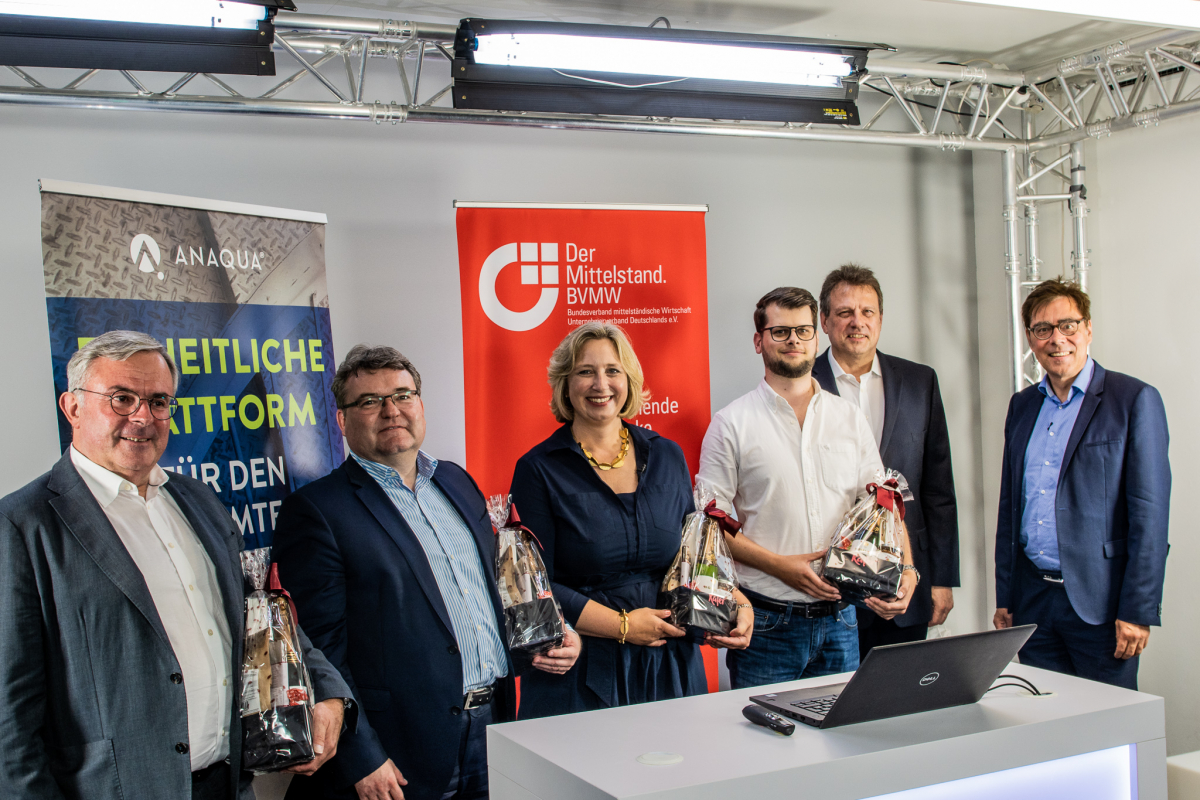
I. Alexandra Dellmeier introduced the topic by providing an all-around view of the European Union's new draft regulation published on 21 April 2021. Click here for the slides in English.
II. Jonas Delkurt is an experienced IP Software Specialist and works for ANAQUA as a Solution Consultant in London. He answered questions about what artificial intelligence is exactly, where it can be used and the aspects are important with respect to artificial intelligence.
III. Dr. Andreas Gallasch is CEO of Software Factory. He spoke on the topic of "AI used in Industrial Production". In particular, he addressed the goals pursued using AI in production and the possible applications.
IV. Dr. Bernd Haberlander is a (European) Patent Attorney at the law firm Hinkelmann. His contribution to the webinar focused on the question of whether AI is reliable.
To watch the entire webinar in German, please click here.