

Picture this: on a sunny morning, you peek into your mailbox (the real one, not your emails) and find a pretty envelope. As you reach for it with childish excitement, you ask yourself who had the lovely idea to send you a postcard from their summer vacation. Then you open it and realise it is a cease-and-desist letter from a lawyer. It turns out that you keep using their client’s songs in your Tik-Tok videos without authorization and they want you to stop “infringing their copyright”. Your disappointment is immeasurable, and your day is ruined. And your bank account potentially as well, since they also demand a hefty payment. If you are an influencer and would like to avoid this type of situation, this article is for you.

- Be aware of the dangers of intellectual property infringement
What is “IP right infringement”?
In the context of IP, “infringement” refers to the use of another person’s IP rights without being duly authorized to use these rights. Since IP rights are exclusive, one needs to either get permission from the IP right owner to use it for a certain amount of time (licence agreement) or obtain property of the IP right from its owner (purchase agreement). To learn more about the most important IP rights (trademarks, designs and copyright), please refer to Part 1 of our guide for influencers (https://lexdellmeier.com/en/blog/guide-influencers-part-1-protecting-your-own-intellectual-property).
What do you risk in case of infringement?
IP rights are geographically limited to individual countries or regions, whose laws may provide for different sanctions. But overall, even in good faith, an influencer promoting fakes or using IP rights without due authorisation from their owners risks:
- Court orders prohibiting further unlawful use of the IP right (so-called “injunctions”)
- Payment of damages and legal fees
- For extreme cases: criminal charges (payment of fines, imprisonment for several years)
- Do your research before posting: look for the existence of third party rights
Trademarks and designs:
- Before dropping names or showing logos in a post, ask yourself whether others have applied for trademarks or designs for the same;
- Worldwide databases such as TMView (for trademarks: https://www.tmdn.org/tmview/#/tmview) and the WIPO Global Database (for designs: https://designdb.wipo.int/designdb/en/) contain information on most registered rights and are accessible free of charge: run a brief search to see whether third party rights may be a problem;
- If you find results that worry you: inform the right owner of your intention and ask for their permission to use the right (in writing), or seek the legal opinion of a professional attorney to lift any doubts you may have regarding a sign’s availability.
Copyrights:
- Copyrights are obtained automatically and not registered (at least in most countries), so the only helpful databases will be those that list works that have fallen within the public domain or works that are shared under open licences (such as Europeana: https://www.europeana.eu): this content will be safe to use;
- Ask yourself whether the use you want to make of someone else's work falls within a copyright exception: for instance, in the EU, use of copyrighted content is allowed for the purpose of parody, or quotation for criticism or review. In such cases: do not forget to mention the source and author in your post (otherwise the exception may not apply)!;
- In establishing whether the work is not free to use and/or your post would benefit from a copyright exception, do not hesitate to ask for the opinion of a legal practitioner;
- Once you are certain that the post you are about to make would be infringing copyright, either contact the owner to obtain their authorisation, or find another idea.
- Recommendation: Legal advice upfront
In general, it makes sense to invest some time and money into proper legal advice BEFORE you start a career as a (professional) influencer. Intellectual property rights and the assessment of the risk they may pose are tricky. Therefore, it is good to have a guideline and know some “ground rules” before posting, advertising etc.
For all questions you may have on this topic, please contact our dedicated colleague Pierre Gerber at p.gerber@lexdellmeier.com and info@lexdellmeier.com and we will arrange a 20-minute Teams call to discuss your specific questions or concerns. A first contact and overall input is generally free of charge.
New Name, Legal Check
Rebranding and Trademark Law – What You Need to Know When Changing Your Brand Name
Rebranding can be an exciting yet risky move for any business. Whether you are modernizing your image, merging with another company, or simply trying to distance yourself from a negative past, changing your brand name is a significant step. But while marketing and design often take centre stage in rebranding projects, the legal dimension – especially trademark law – is just as critical. A poorly managed brand transition can lead to infringement claims, lost brand equity, and expensive disputes.
Here is a guideline from a trademark law perspective when considering a rebrand – and where we can support you.
1. Why Trademark Law Matters in Rebranding
Your brand name is more than just a label – it is a legally protected asset. A registered trademark gives you the exclusive right to use your name (or logo) in connection with your goods or services. When you change that name, you may be walking into a legal minefield:
- Is the new name already registered by someone else?
- Does your new name look or sound too similar to an existing trademark?
- Are you at risk of being sued for trademark infringement?
Failing to address these questions early can derail your rebrand and cost your business dearly.
2. Conduct a Thorough Trademark Search
Before settling on a new name, conduct a full trademark clearance search. This involves more than a quick Google or domain check.
It is highly recommended to work with a trademark attorney for this process. They can spot potential conflicts that might not be obvious at first glance.
We can assist you with:
- Performing clearance searches in the territories of interest
- Providing our assessment as to the remaining risks
- Creating possible alternatives.
3. Assess the Risk of Confusion
Trademark infringement does not require identical names – it is enough if two marks are “confusingly similar.” This is assessed based on:
- Visual and phonetic similarity
- Similarity of goods or services
- Overlapping target audiences
- Marketing channels used
For example, changing your brand from “QuickFit” to “KwikFyt” might seem original, but courts may still find confusion if “QuickFit” is already protected.
4. Register Your New Trademark Early
Once a legally safe name has been searched and chosen, register it as a trademark as early as possible – ideally before you launch the new brand.
This is important for:
- Securing exclusive rights to the name
- Preventing others from registering it
- Gaining legal leverage in case of conflict.
We do of course assist our clients in filing and managing their trademark portfolios worldwide.
5. Do not Abandon Your Old Trademark Too Soon
One common mistake is to completely drop the old brand identity the moment the new one is launched. But that can cause legal and business issues:
- End of trademark protection: trademark protection is terminated in the moment the duration ends. Contrary thereto, products may be “phased-out”.
- Loss of brand equity: Especially if your old name still holds trust.
- Trademark lapse: If you stop using a trademark and do not renew it, it may become vulnerable to cancellation.
- Consumer confusion: Abrupt changes may confuse existing customers or weaken your brand’s legal distinctiveness.
Best practice: Keep both brands in parallel for a while. Use phrases like “formerly known as…” or “now [new brand]” during the transition period.
6. Update Legal Agreements and IP Assets
Once your new brand is live, make sure you update all relevant legal and business materials, including:
- Commercial contracts
- Licensing agreements
- Domain names
- Social media handles
- Packaging, signage, and advertising
- Trademark records with IP offices
Neglecting this step can cause inconsistencies, contract disputes, or even a loss of trademark rights.
7. Timing is key
Once the decision to rebrand is made, legal due diligence should start immediately.
Trademark clearance, registration and coordination with international offices can be time-consuming – and delaying these steps risks conflicts, delays or even forced renaming. Legal processes must run in parallel with creative and strategic planning.
Ideally, businesses should allocate at least 6 months, and up to 24 months for more complex, international brand changes.
Conclusion: Rebranding Is a Legal Project, Not Just a Marketing One
Rebranding is much more than picking a catchy new name and designing a fresh logo. It is a legal process with significant trademark implications. Failing to do your homework can put your new brand at risk before it even launches. Timing is key – early legal involvement helps ensure a smooth and secure rebranding journey.
We can help you to conduct proper trademark checks, provide legal advice, register your new brand early, and plan the transition carefully. That way, your rebrand can be a fresh start – not a legal headache.
You are always welcome to contact us for further information, either by email to info@lexdellmeier.com or by phone at +49 89 55 879 870.
SUMMER – FESTIVAL TIME – BUILDING TRADEMARK VALUE
Well over two months late for World IP Day, but still keen to talk about IP and music.
Per chance, I recently listened to an OMR podcast with Holger Hübner, one of the founders of the Wacken Open Air festival and I was surprised how focused he was on brand management and the implications it has. More than once he reiterated that “the brand takes precedence over everything.” What a great example of how Intellectual Property (IP) and music go hand in hand.

(Source: Shutterstock, ID: 2293214123)
- Introduction
With all the music festivals taking place in summer, it becomes clear that the relationship between IP and music cannot be reduced to the name of a band or a song, but that it is much broader. It is about credibility, building assets, retaining your customer base and last but not least – on a personal basis – having a good time with old friends and making new ones. For those of you that are not familiar with the Wacken Open Air festival, let me give you a few facts about it.
- The Festival
The Wacken Open Air Festival, or WOA, was founded by friends that could not get enough of heavy metal music and wanted to share that spirit with others. In the small town of Wacken located in the very north of Germany they were able to gather 500 likeminded people for their first festival in 1990. 35 years later, the event attracts over 80,000 heavy metal and rock fans from all over the world. The 2025 festival tickets were sold out fast – and long before it was announced that Guns N’ Roses were going to head the lineup.
The festival’s “holy ground” is an area of over 360 hectares of rural acker in Wacken which are farmed normally during the year – with electricity and telecommunication cables and even a beer pipeline buried deep in the ground to not affect the farm work and still cater the festival.
As you can imagine, 80,000 fans are not just challenging for the festival organizer, but also have a considerable impact on a small, rural community like Wacken with only about 2,100 inhabitants (see www.wacken.de). Overall, there are quite a few stakeholders that need to be taken into account when planning a festival of this size and each decision affects the festival and the brand build upon it.
- The Brand
Referring to “the brand” is an understatement. The festival brand is backed by several registered trademarks led by
a. word marks like
- “Wacken Open Air” (e.g. DE 399 03 206) or
- “W:O:A” (e.g. DE 301 51 011 or EUTM 018354678),
b. mere figurative marks like
(e.g. DE 399 03 209),
c. word/device marks like
(e.g. EUTM 007360985) (e.g. EUTM 008934127)
The trademarks are used broadly on merchandise like clothing, headwear, towels, blankets, glasses, mugs, toys and much more. The festival even has its own Monopoly game:
(see https://festivalstore.wacken.com/products/w-o-a-monopoly)
But coming back to the OMR podcast with Holger Hübner… Hearing him emphasize several times that “the brand takes precedence over everything“ it became clear that every decision regarding the festival is made with a strong focus on the implications it has:
- Is it in favor of the brand? Does it enhance or endanger the brand?
- Does it have any advantage for the fans, for the heavy metal community?
- Is it sustainable? Does it allow the “holy ground” to stay as is – a rural acker?
If an offer is not at least meeting these criteria, it is being turned down – regardless of the monetary value it might have as the negative impacts on the brand could be significant.
Our firm is not representing the Wacken Open Air festival trademarks, but being a trademark attorney, listening to this podcast was very enlightening and encouraging as it showed firsthand the appreciation and value that trademarks have to brand owners. Being part of a professional community that helps the latter securing and enforcing their trademarks to ensure that all the brand awareness and brand management pays off, feels good.
Should you also have a trademark that you would like to legally protect to ensure that no one else takes advantage of or even harms your brand, you are always welcome to contact us for further information on trademark law, either by phone at +49 89 55 879 870 or by email to info@lexdellmeier.com.
Have you ever posted a video of yourself performing a little dance on TikTok? Or uploaded photos of your latest vacation on a sun-bathed island on Instagram? There is a good chance that you did, since more than 5 billion persons are currently social media users, which represents roughly 64% of the world population. If you post on social media regularly and receive payments for doing so by commercial partners, congratulations: you may call yourself an influencer! No matter what the haters say about it, your activity on social media is an actual business. The contents you create are valuable and therefore deserve protection. In this article, you will learn a few basics on how to protect your own intellectual property.

- Acquire relevant intellectual property rights
Trademarks: Any sign you may be using to distinguish services you provide or goods that you sell from those of other businesses may be registered as a trademark. Examples:
- A specific name or pseudonym under which you post content
- A logo that you use in your videos, as your profile picture, on products you created and offer to buyers…
- A musical theme or a jingle that can be heard in your videos
Trademarks need to be registered and are only valid in the countries where they are registered. They allow you to prohibit others from using a similar sign with similar goods and services to those for which you claimed protection. This right lasts 10 years and can be renewed for 10-year periods.
Designs: The appearance of products (or parts of products) that results from their features, such as lines, contours, colours, shapes or textures may be protected through a design. They are valid for 5 years, renewable for periods of 5 years and with a maximum of 25 years.
Important: Registering and renewing trademarks and designs is possible both at a national level and for the whole EU. However, it implies paying fees to the relevant intellectual property offices. Unless you have an unlimited budget, you will have to devise a strategy (meaning: define which signs you need to protect, for what goods or services, and in which countries) if you want to secure efficient protection of your IP through these rights.
Copyright: This right protects all creative works, be it artistic, musical, literary or audiovisual, if the works express the author’s free and creative choices. It is generally obtained automatically after the creation of the work (meaning no registration is necessary) and stays valid for 70 years after the author’s death. A few examples of copyrighted works are:
- The music and lyrics that can be heard in a song
- The contents of a video
- Pictures or photographs (even memes !)
- If you are hiding behind a “virtual influencer”: the appearance and animations of your avatar
- Enforce your rights against infringers
Trademarks, designs and copyright grant their owners an exclusive right. This means that no one else may use a registered trademark or design, or exploit a copyrighted work, unless the right holder allows it by granting a license. Making use of a protected sign or work without permission is called “infringement”. By way of court actions against infringers, IP right owners may claim damages and injunctions to stop any infringement.
Here are some important steps to follow for any influencer to protect their intellectual property:
- Stay alert: look out for any unauthorized use of your IP rights by third parties
- Save proof of any infringing behaviour: make screenshots, download any material where your trademark, design or copyrighted work appears without a license agreement in place
- Document your own work and date it (for instance with watermarks, witness testimonies or notaries that can confirm the “creation” of your copyright): this will allow you to prove ownership of a copyright and when this right started to exist
- Seek counsel with legal professionals: we can advise you on any matter pertaining to trademarks, design and copyright. Please contact us at info@lexdellmeier.com and p.gerber@lexdellmeier.com and we will arrange a 20-minute Teams call to discuss your questions free of charge.
- Useful links
For more information, please visit the following links:
https://www.euipo.europa.eu/en/observatory/awareness/ideas-powered/ip-for-influencers
IP Right Holders do better
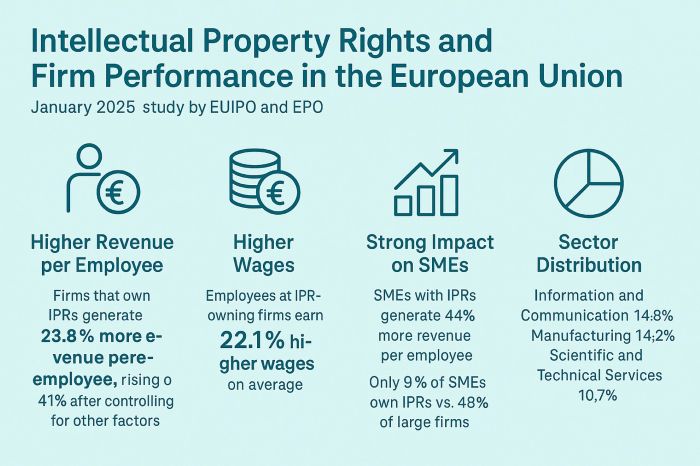
Findings of the “Intellectual Property Rights and Firm Performance in the European Union” firm-level analysis report by the EUIPO (European Union Intellectual Property Office) and the EPO (European Patent Office) of January 2025
Background and Objective of the Study
This study investigates the impact of Intellectual Property Rights (IPRs) – including patents, trademarks and registered designs – on the economic performance of companies in the EU. It covers both large firms and small and medium-sized enterprises (SMEs). The goal is to highlight the strategic importance of IPRs in enhancing business growth, innovation, and competitiveness.
Key Findings
1. Higher Revenue per Employee
Firms that own IPRs generate:
- on average, 23.8% more revenue per employee than firms without IPRs.
- after controlling for variables such as sector, company size, and location, the revenue advantage increases to 41%.
2. Higher Wages
- Employees at IPR-owning firms earn 22.1% higher wages on average than those at firms without any IPRs.
3. Strong Impact on SMEs
- SMEs with IPRs perform significantly better, generating 44% more revenue per employee compared to SMEs without IPRs.
- However, only about 9% of SMEs in the EU own any form of IPR, compared to 49% of large companies.
4. Sector Distribution
Firms owning IPRs are more commonly found in:
- Information and Communication (14.8%)
- Manufacturing (14.2%)
- Scientific and Technical Services (10.7%)
5. Multiple IPRs = Greater Advantage
- Companies that own more than one type of IPR (e.g., both patents and trademarks) experience an even stronger positive impact on performance.
Conclusion: The Strategic Importance of IPRs for European Businesses
The 2025 study by the EUIPO and EPO clearly demonstrates that IPRs are not merely legal tools – they are key strategic assets that significantly enhance business performance, particularly in today’s highly competitive, innovation-driven economy.
While large firms more frequently register IPRs, the report highlights that SMEs benefit the most when they do so. SMEs with IPRs generate 44% more revenue per employee – a transformative figure for businesses operating with limited resources. Despite this, only 9% of SMEs currently hold registered IPRs. This gap represents a missed opportunity and highlights the urgent need for greater awareness, support, and access to IP systems for smaller firms.
Final Takeaway
Intellectual property rights are no longer optional for firms seeking growth—they are a strategic necessity. For both policymakers and business leaders, the message is clear:
- Encourage investment in IP
- Build support structures for SMEs
- Integrate IP strategy into core business planning
In a knowledge-based economy, the ability to create, protect, and leverage intellectual assets is a decisive factor for success – both at the firm level and for the broader European economy.
The full report is accessible under https://www.euipo.europa.eu/de/publications/firm-level-analysis-report-january-2025.
COMING UP ON 1 MAY 2025: AMENDMENTS TO EU DESIGN LAW
We recently held a webinar on the upcoming amendments to EU design law. To learn more about the new amendments, listen to our webinar recording which will be uploaded soon on LexDellmeier’s YouTube Channel at www.youtube.com/@lexdellmeier-intellectualp8494. Most changes will be applicable as from 1 May 2025, others will have to wait until 1 July 2026 when secondary legislation comes into force. Here is some practical advice on the current changes.
- Background
After more than 20 years of successful design protection in the European Union, EU design law has been updated to meet the new challenges of the digital age and to better protect the rights of design holders while ensuring effective competition in the interest of consumers.
- Practical Advice
While most changes in the EU Design Regulation (EUDR) will generally be applicable as from 1 May 2025, some amendments need further clarification – in particular with regard to technical and other formal requirements which have not yet been defined. As one of the main aims of the new changes to EU design law is to further harmonize the design laws between the individual EU member states and the EUIPO, these technical and other formal requirements have to be discussed and agreed on between the national design offices of the EU member states and the EUIPO. While this process has already been started, it will still take some time until consent is reached. Until then, we will – unfortunately – have to rely on the old provisions. For instance, we will most likely not know until the middle of 2026 which (mostly technical) means of representation the EUIPO will allow for new forms of designs. Thus, design applications including movements, transitions or other forms of animation will have to wait until 1 July 2026 at the latest until they can be applied for. But there are some other important issues to be aware of and to take into account even before 1 May 2025.
- Renewal
Check if any of your designs will be due for renewal before 1 November 2025. If so, we strongly recommend to check if you can save money by renewing the design(s) by 30 April 2025 as the latest. On 1 May 2025, the renewal fees will increase significantly. For instance:
-
- For the first (1st) renewal of one (1) design, you will have to pay EUR 90.00 until 30 April 2025 and EUR 150.00 as of 1 May 2025.
- For the forth (4th) renewal of one (1) design, you will have to pay EUR 180.00 until 30 April 2025 and EUR 700.00 as of 1 May 2025.
IMPORTANT: As of 1 May 2025, the renewal fees will be due on the date of expiry of the registration instead of on the last day of the month on which protection ends. We recommend to adjust your docket accordingly.
- Deferment of Publication
The design registration fee that has to be paid at the time of filing your design application will cover the (old) application and publication fees.
IMPORTANT: If you would like to defer publication of your design application filed as of 1 May 2025 (deferment is possible for up to 30 months), you have to pay the official deferment fee at the time of application. If you request deferment, but do not pay the deferment fee, the EUIPO will reject your whole design application, not just the request for deferment of publication.
IMPORTANT: If you request deferment of publication, your design will be automatically published at the end of the 30-months deferment period. If you would like to prevent your design from being published, you have to actively withdraw the application until 3 months before the end of the deferment period.
- New Design Protection Symbol
Enhance visibility of your design rights by using the new design protection symbol consisting of a D in a circle - like the C for copyrights and the R for registered trademarks!
Again, to learn more about the new amendments to EU design law, listen to our webinar recording which will be uploaded soon on YouTube at www.youtube.com/@lexdellmeier-intellectualp8494. In addition, you are always welcome to contact us for further information on the new EU design law, either by phone at +49 89 55 879 870 or by email to info@lexdellmeier.com
Few are those nowadays who have not heard of the wonders of machine learning technologies. Names such as “ChatGPT”, “DeepSeek” or “Midjourney” have become known to virtually everybody and, for many, are now part of our everyday life. Writing a moving poem, drawing a realistic picture or composing a pretty melody has never been as easy as with the help of these new virtual assistants. As artificial intelligence (so-called “AI”) becomes increasingly involved in creative processes, the question of whether copyright protection may be granted to AI-generated content becomes more relevant by the day.

- No specific public policy despite great economic significance
As of today, there is no national legislation addressing specifically the copyright protection of AI-generated content in the EU Member States. The EU “AI Act”, which entered into force on 1 August 2024, also remained silent on the question of copyrightability of AI-generated works. Case law on this particular issue is very scarce across Europe. Yet, the arrival of easily accessible, well-functioning AI-tools already has had a considerable impact on the creative industries and is expected to continue to have a transformative effect on the economic reality of artists. As an example, according to a joint study by GEMA and SACEM (Collective Management Organisations representing authors and composers respectively in Germany and in France) dated 30 January 2024:
- the market for generative AI in the music sector alone is estimated at around 300 million USD for the year 2023, and is expected to reach 3 billion USD by 2028 – this would correspond to 28% of global music copyright collections;
- 35% of music authors and creators declare having used AI technology in their creative work – this number rises to 51% for those under the age of 35;
- 93% of music authors and creators demand that policymakers “pay more attention to the challenges related to AI and copyright”.
- Tips to verify copyrightability of works created with the help of AI
Unsurprisingly, there is a global consensus that copyright necessitates human authorship. Public authorities around the world have excluded copyrightability of contents exclusively generated by AI without human intervention. However, according to a Policy Questionnaire of the Council of the European Union dated 20 December 2024, EU Member States agree that AI-generated outputs may be protected by copyright provided they meet the existing requirements of copyright protection. AI-assisted creations reflecting the personality of the human author and resulting of his or her free and creative choices would thus be protectible. The same approach is taken by the US Copyright Office, who nonetheless stated in its Report “Copyright and Artificial Intelligence” of January 2025 that prompts input into the AI alone do not constitute sufficient human intervention, even with a high level of detail and successive revisions of the prompts.
Based on these principles, here are some things to consider for (human) authors using artificial intelligence to ensure that their creation may enjoy copyright protection:
- Do not limit yourself to written prompts: expression of your creativity may be more visible in outputs generated by other types of input that may be copyrightable in themselves (such as drawings or sounds);
- Use AI-generated outputs as intermediate steps: re-working and editing an output yourself will increase the likeliness of having the final product qualify as a “work”;
- If you insist on letting the AI do most of the heavy lifting: try rearranging and assembling multiple AI-generated outputs into one single piece, as a well-thought combination of outputs may yet be sufficiently original;
- Document everything: from your inputs to your very last tweak on the final work, make sure that you are in a position to prove the extent and intensity of your personal intervention in the creative process.
- Useful links
For more information, please visit the following links:
https://www.gema.de/en/news/ai-study
Virtual Goods in Focus – EU General Court’s First Ruling
The General Court (GC) has issued its first-ever ruling on the distinctiveness of a trademark applied to virtual goods. The decision T11163/23 dated 11 December 2024 – “Glashütte ORIGINAL” concerned the application for the following sign:
- Background of the case
The European Union Trademark (EUTM) application no. 018727034 dated 1 July 2022 covered (inter alia) “downloadable virtual goods such as watches, clocks, and their accessories for online use or use in virtual worlds” (Class 9), as well as “retail services and the provision of these virtual goods” (Classes 35 and 41).
With EUIPO decision of 13 February 2023, the application was provisionally refused for the above-identified goods and services due to Art. 1 (1) (b) – lack of distinctiveness. The Examiner found, in essence, that the mark applied for would, for a non-negligible part of the relevant German public, evoke the reputation of the town of Glashütte (Germany) of excellence in the horological sector, in so far as, even in the context of virtual goods, the goods and services at issue all referred to horological goods and their accessories.
The appeal filed by the applicant on 12 April 2023 was rejected by the EUIPO Board of Appeal on 29 September 2023, who confirmed the EUIPO 1st instance’s findings.
By its action to the General Court, the applicant, Glashütter Uhrenbetrieb GmbH – Glashütte/Sa., seeks the annulment of the EUIPO BoA decision of 29 September 2023 (Case R 773/2023-5).
- The GC’s decision
The applicant relied on a single plea in law, alleging infringement of Article 7(1) (b) of Regulation 2017/1001. It complains that the Board of Appeal erred in finding that the mark applied for lacked distinctive character in respect of the goods and services. According to the GC, that single plea consists, in essence, of four parts, relating, first, to the reputation of the town of Glashütte in the horological sector, second, to the extension of that reputation to the virtual goods and services at issue, third, to the distinctive character of the figurative characteristics of the mark applied for and, fourth, to the registration of a similar mark.
However, while the GC dealt with the question of how to examine “virtual goods” and services related to such virtual goods, the Court missed the opportunity to establish new and specific examination criteria for this quite new category of goods by merely concluding that the relevant public would tend to interpret virtual goods in the same way as their physical counterparts.
Glashütte: A Symbol of Watchmaking Excellence
The GC confirmed that Glashütte, a town in Saxony near Dresden, is renowned for its tradition of high-quality watchmaking. This reputation shapes how the relevant public perceives the sign, even in the virtual realm: “(…) although it is common ground that the reputation of the town of Glashütte in the traditional horological sector does not currently extend to the field of virtual watchmaking, as the applicant claims, the fact remains that the goods and services at issue expressly refer to horological goods and their accessories”. According to the court, the public will view virtual watches in the same way as physical ones. As a result, the sign will not be perceived as an indicator of origin but rather as promotional information about the quality and authenticity of the goods.
The Transfer of Perception from Real to Virtual Goods
The GC noted that for virtual goods resembling or emulating physical goods, there is generally a transfer of perception: the relevant public tends to interpret virtual goods in the same way as their physical counterparts. However, this transfer must be assessed on a case-by-case basis, considering the specific nature of the virtual products and services.
In this case, virtual watches may represent physical watches or imitate their functions. Therefore, the public will directly associate the trademark with the reputation of Glashütte in traditional watchmaking. Consequently, the sign “Glashütte original” will be seen as a logical extension of the town’s reputation and as promotional information rather than a distinctive trademark.
- Comment LexDellmeier
The applicant can still (and should) bring an action before the European Court of Justice (ECJ). There is a simple reason for that as several “Glashütte Original” trademarks are registered at the EUIPO and WIPO (e.g. EU 004821773 / IR). Some of these trademarks are also (still) protected for the goods “watches” (class 14) (real - not virtual...). After the GC’s latest judgment regarding “virtual goods” and the analogy to “real goods”, the question arises as to whether these registrations could possibly be challenged or be ready for cancellation due to lack of distinctiveness. From the point of view of a trademark practitioner and in view of the trademark owner’s interests, Glashütte should take action against this development.
For more information, please find extracts of the decision here: https://eur-lex.europa.eu/legal-content/EN/TXT/?uri=CELEX:62023TJ1163.
Has the European Union Intellectual Property Office (EUIPO) rejected your trademark application but the decision is not yet final? Consider withdrawing the application to keep the option alive to convert your application into national trademark applications in individual EU Member States – without the restrictions that apply to conversion after final refusal.

Background
If you file a new European Union trademark application, the EUIPO will, inter alia, examine if the applied for sign is distinctive for the designated goods and services in ALL of the European Union territory. If it is not, your application will be rejected – even if the bar to registration only exists in part of the EU. This is a consequence of the unitary character of a European Union trademark which grants protection in all 27 EU Member States with just one (1) registration.
Obviously, a rejection of your trademark application based on a lack of distinctiveness or a descriptive character in only part of the EU will not invalidate your desire and need for trademark protection in those parts of the EU where the application is not descriptive, but distinctive.
In such situation, the question arises whether or not – and at which point(s) in time - the applicant is offered the possibility to convert an European Union trademark application into national applications in individual EU Member States while keeping the application date of the European Union trademark application. Remember: The application date is important if your trademark ever has to be enforced as the EU applies a “first to register” regime and the party with the earliest trademark application date will have the best rights.
Once the rejecting decision has become final, it is clear that that applicant has the right to convert its EU trademark application and to file applications in such Member States for which the EUIPO did not find a lack of distinctiveness (or another bar to registration), see Article 139(2)(b) EUTMR. But what about converting your trademark application if the rejecting decision is not yet final?
On 22 February 2024, the Executive Director of the EUIPO filed a request (the first of its kind) with the Grand Board of Appeal for their opinion on a point of law regarding the possibility of conversion despite a not-yet-final decision refusing an applied for mark. Is it possible to convert an application that has been rejected by the Office but where the rejecting decision has not yet become final? And does it make a difference if an appeal – against the first instance decision or against the Board of Appeal decision - had been filed or not?
Upon publication of the request for a reasoned opinion, relevant stakeholders were invited to submit observation and the matter was discussed.
The Decision
On 15 October 2024, the Grand Board of Appeal of the EUIPO issued its opinion on the Executive Director’s request confirming the following (see R0497/2024-G):
- As long as the EUIPO’s refusal decision has not yet become final, the applicant may withdraw the European Union trademark application.
- It does not make a difference in which instance the application is pending, that is if the application is withdrawn during the period of appeal against the first instance decision, during the appeal proceeding or during the period to further appeal a Board of Appeal decision. There is no relevant distinction between these different periods in time as long as the refusal has not yet taken effect.
- After withdrawing an European Union trademark application, any examination and appeal proceeding becomes devoid of purpose and the possibility of requesting a conversion of the application into national applications in individual EU Member States is opened up.
- There is no restriction as to the Member States in which a national application can be requested following conversion. The restriction of Article 139(2)(b) EUTMR does not apply and a request to convert a withdrawn European Union trademark application into national applications, subsequent to its non-final refusal by the EUIPO, does not constitute an attempt to circumvent the prohibition of Article 139(2)(b) EUTMR.
Strategic Advice
When you receive a decision that rejects your European Union trademark application, consider carefully if you let it take effect or if you withdraw your application before the rejection becomes final as this will influence the scope of your possibilities to convert your European Union trademark application into national trademark applications in individual EU Member States.
Should you have any questions or if you would like to discuss possibilities to convert your European Union trademark application, you are welcome to contact us by email at info@lexdellmeier.com or by phone at 089 55 879 870.
NEW - International Comparative Legal Guide – Designs 2025 – NOW AVAILABLE
If you are looking for practical insights and intelligence on design law in different jurisdictions, the International Comparative Legal Guide published by glg Global Legal Group is a valuable source of information.

Recently published in its 5th edition, the International Comparative Legal Guide – Designs 2025 covers the following countries (in alphabetical order): Brazil, Canada, Chile, Czech Republic, France, Germany, Ghana, Greece, India, Israel, Japan, Mexico, Philippines, Spain, Switzerland, Taiwan, Ukraine, United Kingdom and United States. The individual country chapters are similarly structured and provide directly comparable, annually updated Q&A chapters on different aspects of design law, inter alia, on application and registration procedure, on grounds for refusal and how to overcome them, on opposition and invalidity proceedings (if any) or on design enforcement and possible defenses.
This year, LexDellmeier was happy to contribute the country chapter covering Germany and we gladly invite you to review our chapter – and of course the rest of the legal guide should you look for design related information in one of the other countries.
If you enjoyed reading our country chapter for Germany, we will be glad to hear from you by phone at 089 55 879 870 or by email to info@lexdellmeier.com