
When Two Single Letter Marks Collide Before the EU General Court
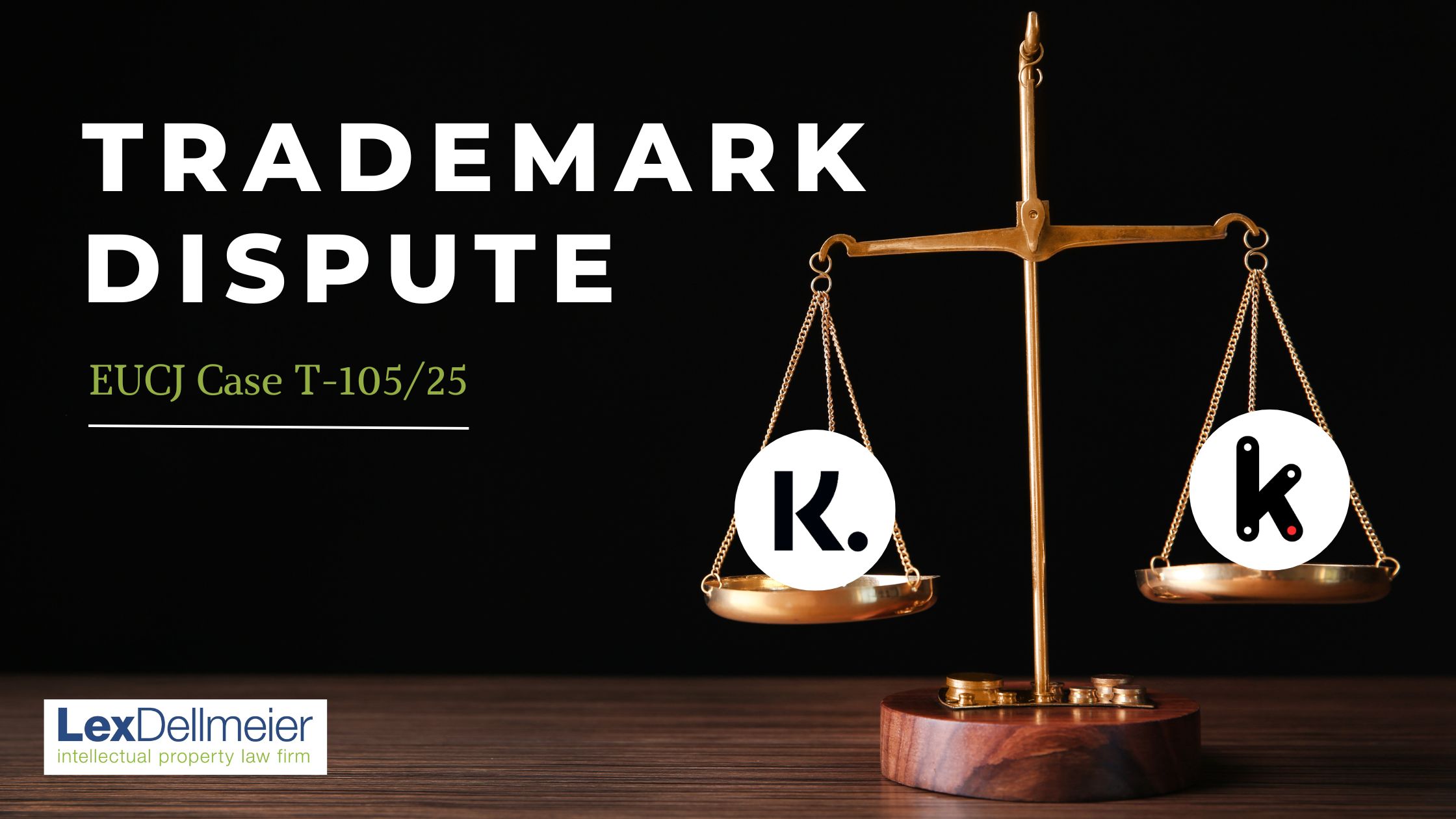
On 13 May 2026, the General Court of the European Union delivered its judgment in Case T‑105/25, concerning a trade mark dispute between Kutxabank, SA and Klarna Bank AB. The dispute arose after Klarna filed an EU trade mark application for a figurative sign featuring the letter “k”. Kutxabank opposed the application on the basis of likelihood of confusion with its earlier trademarks, which also depict a stylized letter “k”. After proceedings before the EUIPO, the matter reached the General Court, whose judgement is the focus of this case summary.
Background
In August 2017, Klarna filed an application for an EU figurative trade mark covering services in Classes 35, 36, 39, 42 and 45. In November 2017, Kutxabank opposed the application in respect of all services claimed. The opposition was based on two earlier rights:
- Earlier Mark 1 (2014): a stylized “k” registered for services in Class 36
- Earlier Mark 2 (2013): the same stylized “k” combined with the verbal element “kutxabank kredit”, registered for Classes 35 and 36
The opposition relied on Article 8(1)(b) of Regulation No 207/2009, alleging a likelihood of confusion.
In May 2019, the Opposition Division upheld Kutxabank’s opposition in respect of all the contested services. Klarna appealed this decision, and the Board of Appeal subsequently partially annulled the Opposition Division’s ruling. Specifically, it rejected the opposition for the services in Classes 35, 39, 42 and 45, while upholding it for the services in Class 36.
In the proceedings before the General Court, Kutxabank sought annulment of the contested Board of Appeal decision insofar as it dismissed the opposition for four service classes. Klarna, in turn, filed a cross‑claim requesting annulment of the remaining part of the decision that had upheld the opposition for Class 36.
Applied mark (Klarna) Earlier Mark 1 Earlier Mark 2



Similarity of goods and services
The Court recalled that similarity must be assessed by considering all relevant factors, such as:
- The nature, purpose and method of use of the services
- Whether they are in competition or complementary and
- Whether consumers expect them to come from the same undertaking
In this case, the services covered by the earlier marks belonged mainly to the financial and banking sector, such as insurance, financial affairs and monetary services in Class 36, as well as general business support services in Class 35. By contrast, the services covered by the applied‑for mark were related to:
- Accountancy and invoicing (Class 35)
- Technological and software‑related services (Class 42)
- Security and investigation services (Class 45)
- Logistics and transport (Class 39)
The Court agreed with the Board of Appeal that these services do not share the same nature or purpose, do not satisfy the same needs of the public, and are not offered by the same types of professionals. They also do not share the same commercial origin or distribution channels.
The only class in which the services were treated as identical was Class 35, as the EUIPO had found identity and Kutxabank had not contested that finding. For this class, the Court proceeded to examine whether the signs themselves were similar and, consequently, whether a likelihood of confusion could arise.
Similarity of signs
The comparison of signs focused on the applied‑for mark and Earlier Mark 2, as this earlier mark covered the identical Class 35 services. The Court assessed visual, phonetic and conceptual similarity based on the overall impression of the marks.
Although the verbal elements “kutxabank” and “kredit” appear in smaller font and in the lower part of the sign, the Court held that they remain sufficiently noticeable for the relevant public. They therefore form an essential component of the mark, meaning that the comparison had to be carried out on the sign as a whole rather than focusing solely on the stylized letter “k”.
The Court found:
- Visual similarity: only low, due to differences in stylization and the presence of verbal elements “kutxabank” and “kredit” in Earlier Mark 2.
- Phonetic similarity: very low, as the applied‑for mark consists of a single letter while Earlier Mark 2 contains two full words.
- Conceptual similarity: none, since “kutxabank” evokes the idea of a bank, whereas a single letter conveys no semantic meaning.
Likelihood of confusion
Although the services in Class 35 were identical, the signs displayed only a low degree of visual similarity, a very low degree of phonetic similarity and no conceptual similarity. Earlier Mark 2 was considered to have an average degree of distinctiveness, and the relevant public was deemed to display a high level of attention. In light of these factors, the Court concluded that there was no likelihood of confusion. The main action was dismissed in its entirety, and the EUIPO’s decision was upheld.
Klarna’s cross-claim
Klarna appeared before the General Court with a cross‑claim, arguing that the Board of Appeal erred in finding a likelihood of confusion for the Class 36 services. Klarna did not dispute the Board’s conclusion that the Class 36 services were identical, but challenged only the assessment of similarity between the signs. As a result, the Court had to examine whether the applied‑for sign and Earlier Mark 1 were similar, an assessment more complex than in the main action, given that both signs consist of a single stylized letter “k”.
The court found:
- Visual similarity: higher than average, due to the nearly identical element of a slightly stylized letter “k”, irrespective of certain stylized aspects, such as the dots, which differentiate the signs.
- Phonetic similarity: identical, as both signs are perceived as the letter “k” and are therefore pronounced the same way.
- Conceptual similarity: none, as no conceptual comparison could be carried out because it was not shown that the letter “k” had any particular meaning.
Taking the above observations into account, and noting that the earlier mark had average distinctiveness while the relevant public was considered to have a higher level of attention, the court concluded in its overall assessment that a likelihood of confusion existed in the present case. This was particularly due to the above-average visual similarity of the signs, their phonetic identity, and the identity of the services at issue. In other words, the court agreed with and upheld the Board of Appeal’s finding that a likelihood of confusion was present. The cross-claim was therefore dismissed in its entirety.